What this guide is really about
Ask five Threads scheduling tools how often you should post and you will get five different numbers. One vendor range runs from three to thirty posts per day. Others push a few posts daily. A third warns that posting more than a handful of times a day triggers some kind of penalty. The advice contradicts itself because a lot of it is built on vendor incentives, not your specific account.
The honest answer is that no universal posting frequency exists. The right cadence depends on your audience, your content quality, your capacity to maintain consistency, and what you can actually sustain without burning out. What works for a media account publishing breaking reactions is wrong for a solo coach sharing weekly insights.
Instead of chasing a magic number, this guide gives you a testing framework. You will learn how to set a starting cadence, run a structured four-week test, read the right signals, and adjust intelligently. No fabricated engagement multipliers. No algorithm penalty claims without evidence. Just a practical system you can run yourself.
There is no universal posting frequency for Threads. Start with one to two quality posts per day as your baseline, run a four-week test adjusting only your volume, and let your own analytics decide whether to increase, decrease, or hold steady. Consistency at a sustainable rate beats short bursts of high volume every time.
Set a realistic starting posting cadence you can sustain
Run a structured four-week frequency test on your own account
Know which analytics signals actually indicate a cadence change
Avoid the burnout cycle that derails most Threads strategies
Universal posting numbers from tool vendors are marketing copy, not tested guidance for your account.
Start with one to two posts per day, then adjust based on your own data over four weeks.
Consistency matters more than raw volume. A steady two posts per day beats erratic bursts of ten.
The only honest way to find your frequency is to test it, read your analytics, and adjust with intent.
If you cannot sustain a cadence for sixty days without burnout, it is not your real cadence.
Why No Universal Posting Frequency Works
Every universal Threads posting number shares the same flaw: it treats all accounts as identical. A news account live-posting industry events operates on a completely different rhythm than a solo consultant sharing frameworks. An artist posting process photos has different constraints than a brand running promotional campaigns.
Tool vendors have an incentive to recommend high posting frequencies. If Schedul tells you to post three to thirty times per day, you need a scheduling tool to manage that volume. The recommendation serves the product, not the creator. This is not malicious, but it colors the advice.
The claims about algorithmic penalties for posting too much are equally unreliable when stated as hard rules. Threads uses a ranking system that considers predictions about how your audience will value each post. The Meta Transparency Center documents this system publicly. If you want to go deeper, our explainer on how the Threads algorithm works breaks down each signal. What the ranking system does is prioritize content it predicts your audience will engage with. If you flood your feed with low-effort posts, the issue is not a penalty mechanism. The issue is that your audience predictably values fewer of your posts when quality drops. The system is doing exactly what it should.
The practical takeaway: your posting frequency is a variable you should test and tune, not a setting someone else can hand you.
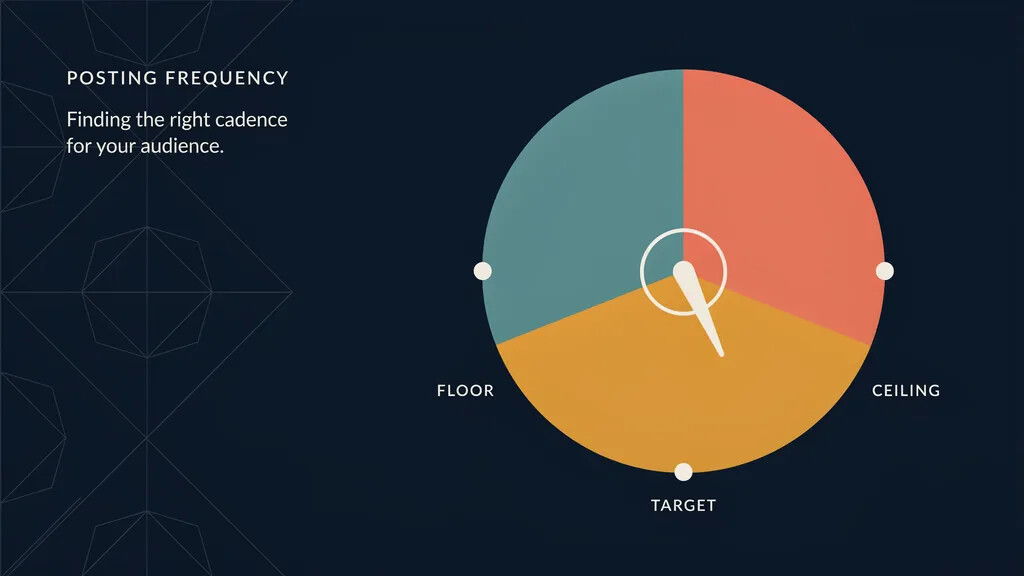
The Cadence Dial: Floor, Target, and Ceiling
Instead of a single number, think of your posting frequency as a dial with three positions. The floor is the minimum you will post to maintain presence and feed eligibility. The target is your planned steady-state cadence. The ceiling is the maximum beyond which quality drops or you risk audience fatigue.
For most solo creators and small teams, a reasonable starting configuration looks like this. Floor: one post per day. Target: one to two posts per day. Ceiling: three posts per day. This is not a prescription. It is a starting hypothesis to test.
Your floor exists because consistency builds audience expectations. If you disappear for a week, people stop looking for you and you give the feed fewer chances to learn what your audience wants from you. Your ceiling exists because there is a real quality-volume tradeoff. If you push beyond what you can write well, every post gets weaker and your audience starts tuning out.
If you already batch content using a production system, your floor and ceiling become much easier to maintain. Batching decouples writing time from publishing time, so you can sustain a steady target even on busy days.
How to Set Your Starting Cadence
Before testing, you need a defensible starting point. Answer three questions honestly. How many posts can you write well in a single week without quality dropping? How much time per week can you dedicate to Threads specifically? What is the minimum cadence that keeps you visible to your audience?
Count the posts you can write well. Not the number you can type. The number you can craft with a clear point, a hook, and a reason for someone to reply. If that number is seven per week, your target is one per day. If it is fourteen, your target is two per day.
Factor in time for replies. Threads is conversational. If you post but never reply, you are broadcasting, not building. Budget at least as much reply time as posting time. A solo creator posting twice daily should plan for roughly twenty to thirty minutes of reply engagement per day.
Now set your dial. Write down your floor, target, and ceiling based on these answers. This becomes your test hypothesis. You are about to validate or correct it with data.
Trusting vendor magic numbers: Scheduling tools recommend high posting frequencies because high volume creates demand for scheduling tools. Their numbers serve their product, not your account. Test your own cadence.
Confusing volume with consistency: Posting ten times one day and zero for the next four days is worse than posting twice every day. The ranking system and your audience both reward predictable presence over erratic bursts.
Testing frequency without controls: If you change posting times, content types, and frequency all at once, you cannot tell which variable caused the result. Hold everything constant except volume during a frequency test.
Ignoring reply time: Posting without replying turns Threads into a broadcast channel. Budget reply time as part of your cadence, not as optional overflow.
Setting a cadence you cannot sustain: If your target requires more writing than you can maintain for sixty days, it is a fantasy target. Sustainability beats intensity over a long enough timeline.
The Four-Week Frequency Test
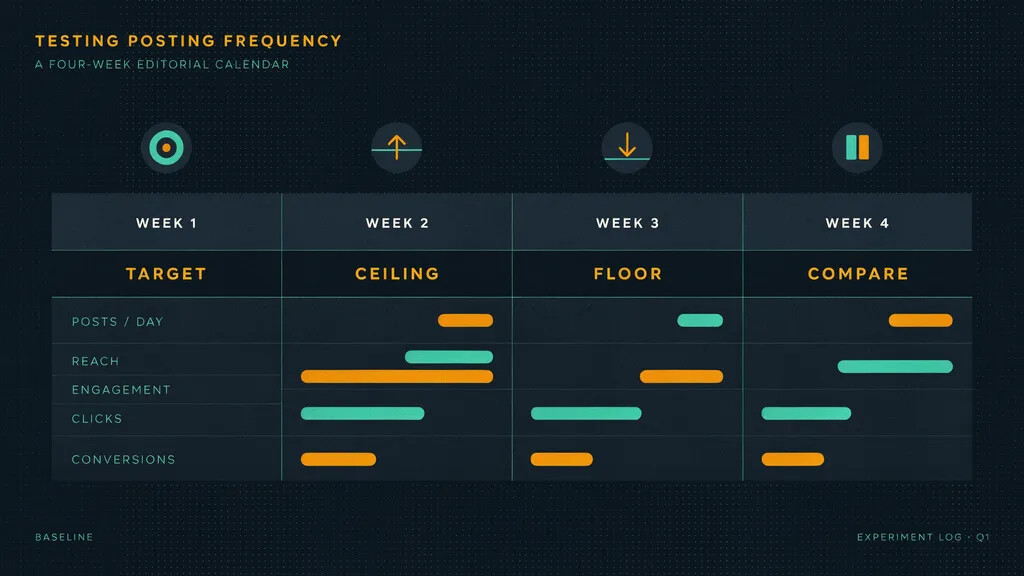
This is the core of the framework. Over four weeks, you change only your posting volume while holding everything else as constant as possible. This is different from finding the best time to post on Threads, which is about timing within a day. Same content types, same posting times, same topic distribution. The goal is to isolate the effect of frequency.
Week one: post at your target cadence every day. Track daily posts published, replies sent, and the basic metrics from Threads Insights: views, likes, replies, reposts, and profile visits. Do not adjust anything. This is your baseline.
Week two: increase to your ceiling. If your target is two per day, post three per day for the entire week. Keep content quality consistent. Track the same metrics. Watch specifically for per-post engagement changes. Are individual posts getting more or less engagement at the higher volume?
Week three: drop to your floor. One post per day. This tests whether the higher volume was diluting your per-post performance or whether the lower volume starves your visibility. Track the same metrics. Week four: return to target and compare. Pull all three weeks of data side by side. Look for patterns. Did week two's higher volume increase total reach but decrease per-post engagement? Did week three's lower volume increase per-post quality but reduce overall visibility? The answer tells you whether your target should move up, down, or stay put.
Signals That Matter and Noise to Ignore
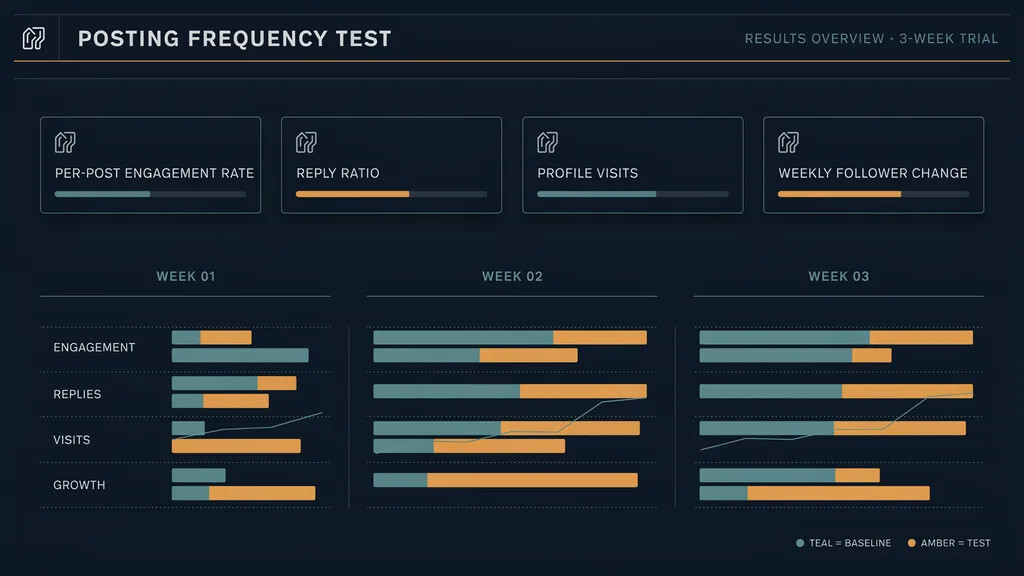
During your frequency test, some metrics matter and some will distract you. Focus on these four signals. Per-post engagement rate: total engagements divided by views for each post. This tells you whether more volume is diluting quality. Reply ratio: replies divided by total engagements. Replies signal genuine conversation, which the ranking system is designed to reward.
Profile visits per post: this indicates whether your posts are driving curiosity beyond the feed. And follower change per week: the net new followers gained or lost. If higher posting volume correlates with follower loss, your audience is voting with the unfollow button.
Ignore single-post outliers. One viral post will skew your week's averages. Look at the trend across all posts in the week, not the peak. Also ignore raw view counts without context. Ten thousand views on a post with zero replies means your content was seen but did not connect.
If you use a content calendar to plan your week, add a frequency tracking column. Note the planned cadence, actual cadence, and weekly metrics summary. Over a month, this becomes your personal frequency dataset.
When to Change Your Cadence
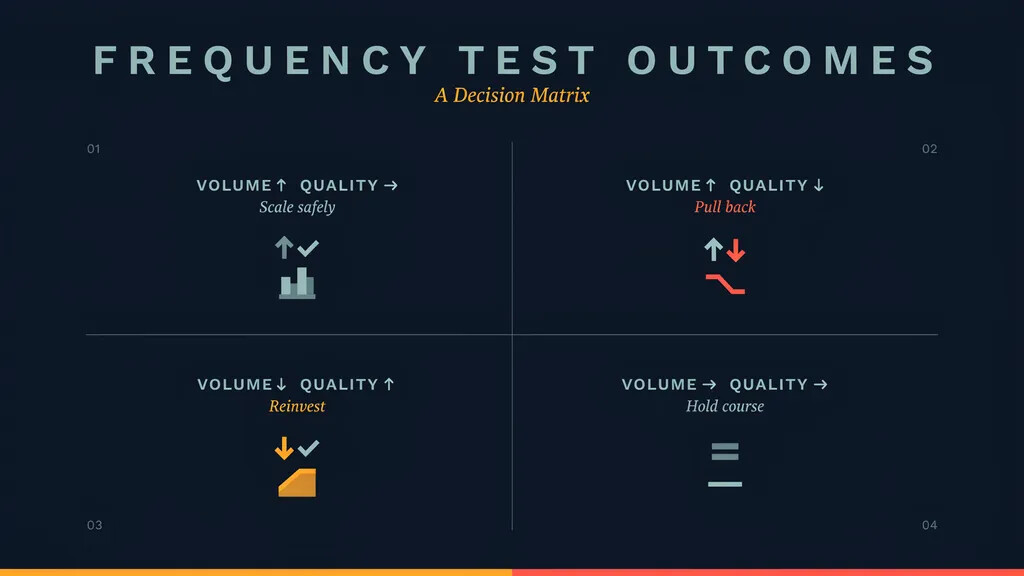
After running the four-week test, you will see one of four patterns. Pattern one: higher volume increased total reach and total engagement without hurting per-post quality. Your target can move up toward your ceiling, but increase gradually and monitor for two weeks before locking it in.
Pattern two: higher volume increased total metrics but per-post engagement dropped. You are trading depth for breadth. This can work if your goal is reach. It works against you if your goal is building a tight community. Decide based on your strategy.
Pattern three: lower volume improved per-post engagement but reduced overall visibility. Your audience values quality over quantity. Keep your target lower and invest the freed time in better hooks, replies, and content depth.
Pattern four: no meaningful difference across all three cadences. This means your audience is not particularly sensitive to volume in this range. Pick the cadence you can sustain most comfortably and focus your energy on content quality and reply engagement instead. Re-run this test quarterly. Audience preferences shift, the platform evolves, and your content skills improve. What worked in month one may need recalibration by month four.
Cadence and Content Pillars: Making Volume Sustainable
A testing framework only works if you can sustain the cadence it reveals. The biggest threat to consistency is not knowing what to post. If every post requires a fresh brainstorm, you will burn out at any frequency above one per day.
This is where content pillars solve the sustainability problem. Pillars give you three to five recurring themes that map to your expertise. Instead of inventing topics daily, you rotate through your pillars. Monday might be a tactical tip. Tuesday a reply-worthy question. Wednesday a behind-the-scenes observation. The structure removes decision fatigue.
Pair pillars with a simple post format system. Short observations, numbered takeaways, open questions, and story-lesson posts cover most Threads content needs. When you know your pillar and your format, writing a post takes minutes, not hours. Learning how to format Threads posts for readability makes each one work harder.
If you want a faster path from idea to published post, the free Threads post creator at JoltSage can help you draft posts from your pillar topics without starting from a blank screen each time.
Action checklist
Use this as the practical next pass after reading the guide.
- +Count the quality posts you can write per week and set your floor, target, and ceiling
- +Add a frequency tracking column to your content calendar or spreadsheet
- +Run the four-week test: target, ceiling, floor, then compare
- +Track per-post engagement rate, reply ratio, profile visits, and weekly follower change
- +Pick the cadence pattern that matches your goal and sustain it for sixty days
- +Re-run the test quarterly or when your audience or content shifts significantly
Conclusion
The right answer to how often you should post on Threads is the one your own data gives you after a structured test. Universal numbers from tool vendors are starting points at best and marketing copy at worst. Set a sustainable floor and target, run the four-week test, read the four key signals, and adjust with evidence instead of guessing.
If you take one thing from this guide: consistency at a cadence you can maintain for months beats any high-volume strategy that burns you out in week three. Find your sustainable rhythm, protect it, and let your content quality do the work.