What this guide is really about
Creating fresh content from scratch every day burns out even the most disciplined creators. Content repurposing solves this by treating what you have already made as raw material for what comes next. But most advice stops at "turn your blog post into tweets" without explaining how to actually transform the format, tone, and structure for each platform. That gap is why repurposed content often reads like copy-pasted leftovers.
This guide gives you a system, not a listicle. You will learn how to identify which sources are worth repurposing, how to transform one piece into multiple formats without sounding repetitive, and how to measure whether your repurposing effort is actually paying off.
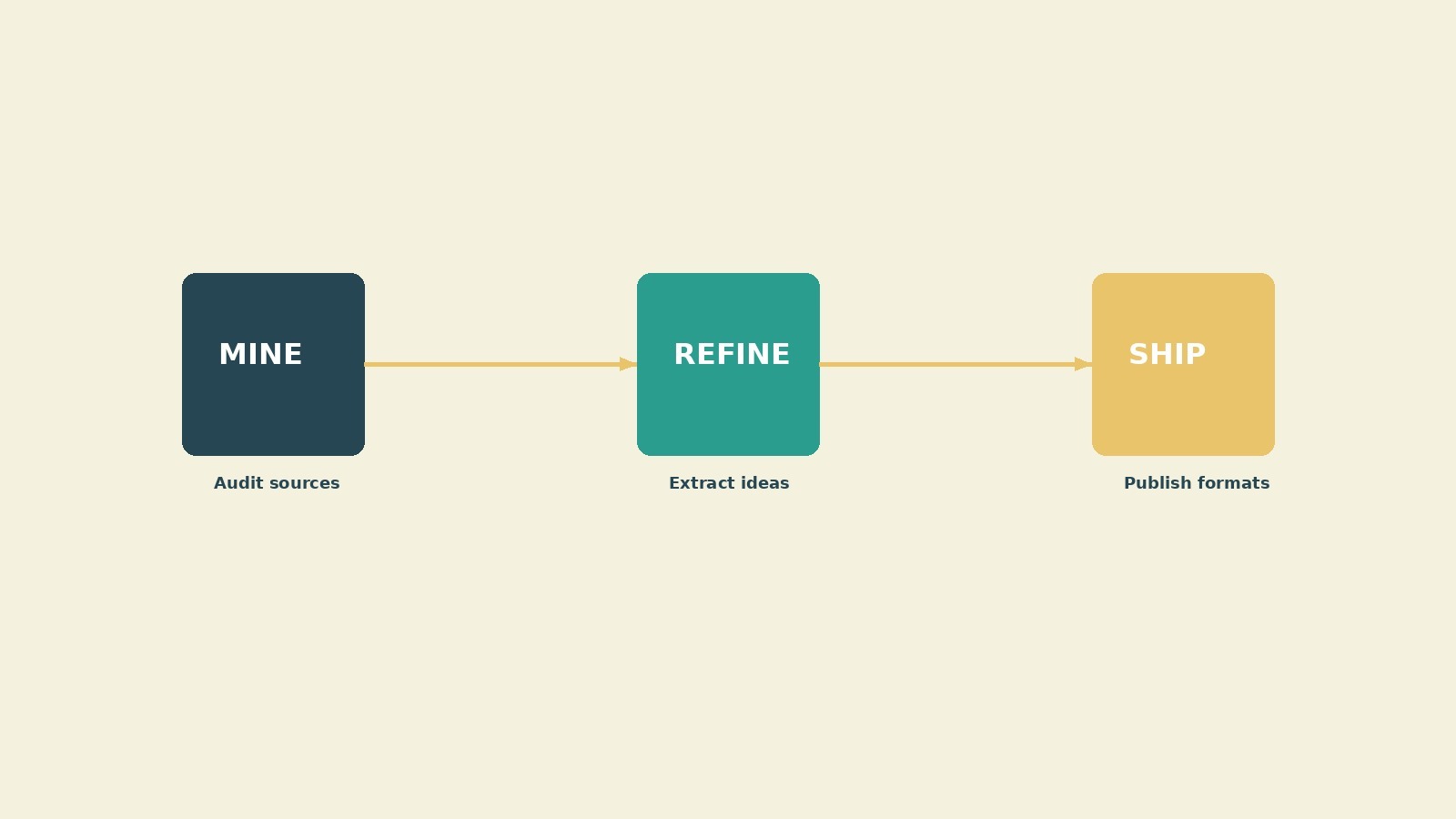
Content repurposing means taking one finished piece of content (a blog post, podcast, video, or thread) and transforming it into new formats for different platforms. Unlike cross-posting, which moves the same message across channels, repurposing changes the format and structure while preserving the core idea. The most effective approach works in three phases: mine your best sources, refine each into a platform-nat...
Repurposing transforms format and structure. Cross-posting moves the same message across channels. Know the difference before you start.
Not every source deserves repurposing. Use a substance test to pick sources with enough material for multiple formats.
The mine-refine-ship system turns repurposing from a random act into a repeatable production step.
Each platform needs its own adaptation rules. What works as a Threads post will not work as a LinkedIn carousel without structural changes.
Measure repurposing by controllable inputs (formats shipped per source, time saved) rather than vanity metrics.
What Content Repurposing Actually Means
Content repurposing takes one finished piece of content and transforms it into a different format for a different platform or audience. A long blog post becomes a series of short posts. A podcast episode becomes a written summary. A customer question becomes a tutorial. The key word is transforms. You are not moving the same thing to a new place. You are rebuilding it so it fits naturally where it lands.
This is different from cross-posting, which shares the same message across platforms with minimal changes. If you already use a cross-posting framework, repurposing is the layer beneath it. Cross-posting asks where else can this go. Repurposing asks what else can this become. Both have a place in a content system, but they solve different problems and produce different outputs.
A third related concept is reposting, which simply re-shares the same content on the same platform later. All three are legitimate, but they serve different goals. Repurposing creates genuinely new assets from existing ones, which means more content per hour of creative work and better fit for each platform's native format. Buffer's guide to repurposing content notes that the goal is to double down on what works by extracting the best ideas and giving them new life in different formats.
The Source-First System: Mine, Refine, Ship
Most repurposing advice starts with the output (turn your blog into tweets) and skips the most important step: choosing the right source. Bad sources produce bad derivatives. A thin social post has nothing to mine. A deep, well-researched blog post can fuel a week of content across multiple platforms.
The system works in three phases. Mine means auditing your existing content for sources rich enough to repurpose. Look for pieces with multiple distinct ideas, frameworks, or data points. A 1,500-word guide with five sections is a better mine than a 200-word opinion post. Refine means extracting the core ideas and deciding which formats each idea fits best. One section might become a Threads post, another a LinkedIn article, another a short checklist. Ship means producing each derivative in the target platform's native format and scheduling it through your content workflow.
This system plugs into existing production habits. If you already batch content, repurposing becomes a step in your batch session rather than a separate task. If you use a weekly content calendar, repurposed outputs fill slots that would otherwise need fresh ideas from scratch. The goal is to make repurposing automatic, not a desperate scramble when you run out of ideas.
Which Sources Are Worth Repurposing
Not every source deserves repurposing. A quick reaction post or a time-sensitive announcement has a short shelf life and limited depth. The best sources are evergreen, structured, and dense with ideas that can stand on their own in a different format.
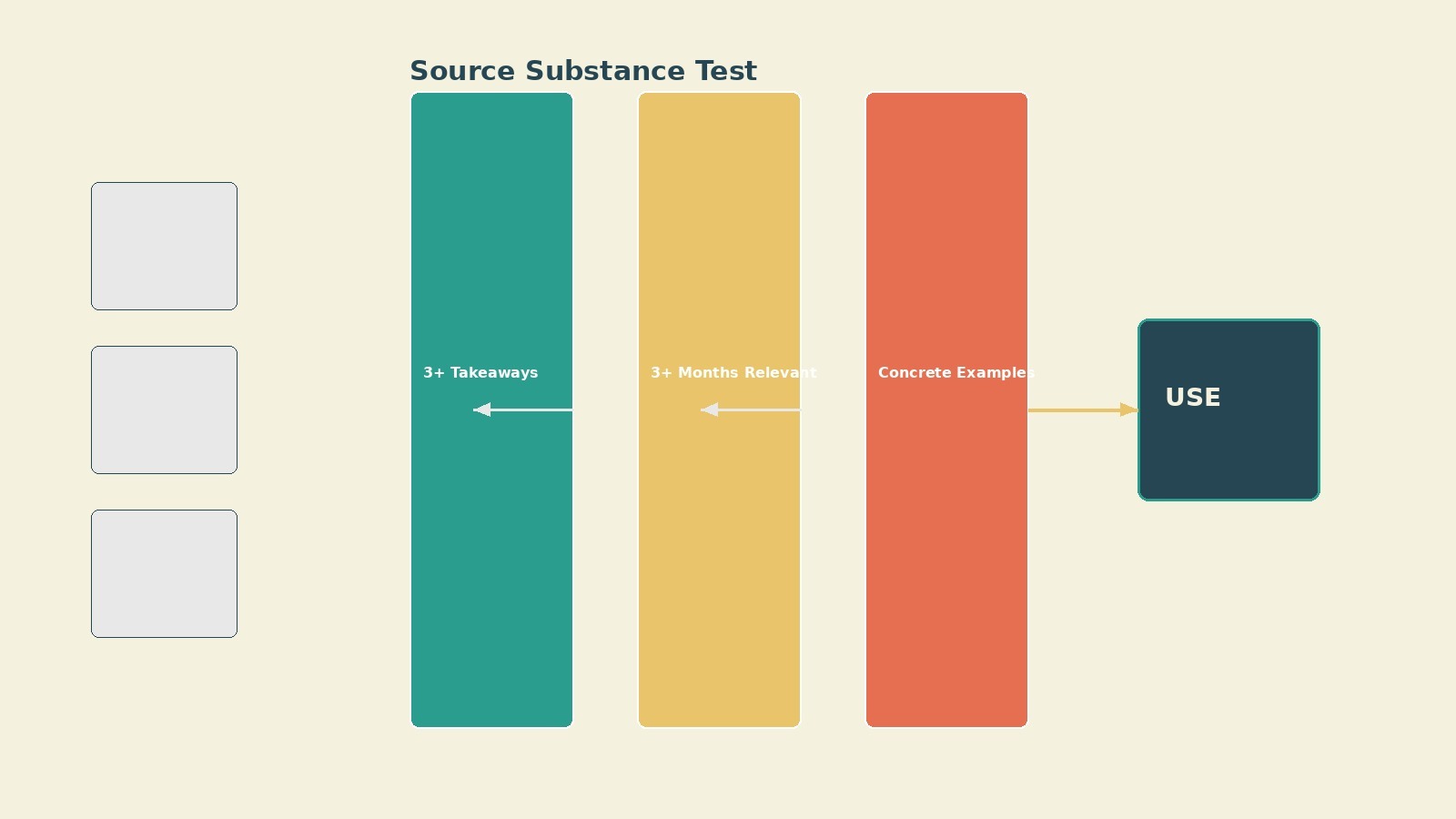
Use this three-part substance test. A source is worth repurposing if it has three or more distinct takeaways, its core message stays relevant for at least three months, and it contains concrete examples, frameworks, or steps rather than just opinions. If a source meets all three criteria, it is a strong candidate. If it meets two, repurpose selectively. If it meets only one, leave it alone.
Strong source types include long-form guides, tutorials, case studies, interviews, and structured comparisons. Weaker source types include news reactions, memes, quick tips, and personal updates. The goal is not to repurpose everything. It is to extract maximum value from the work that already has substance. This connects directly to how you choose content pillars: pillars give you the themes, and repurposing helps you fill them without starting from zero each time.
Repurposing time-sensitive content that is already stale by the time you adapt it.
Treating repurposing as cross-posting (same content, different platform) instead of genuine format transformation.
Trying to repurpose every piece of content instead of selecting high-substance sources.
Ignoring platform-native formats and forcing the same structure everywhere.
Measuring success by total reach instead of format efficiency and time saved.
Format Adaptation: One Source, Five Outputs
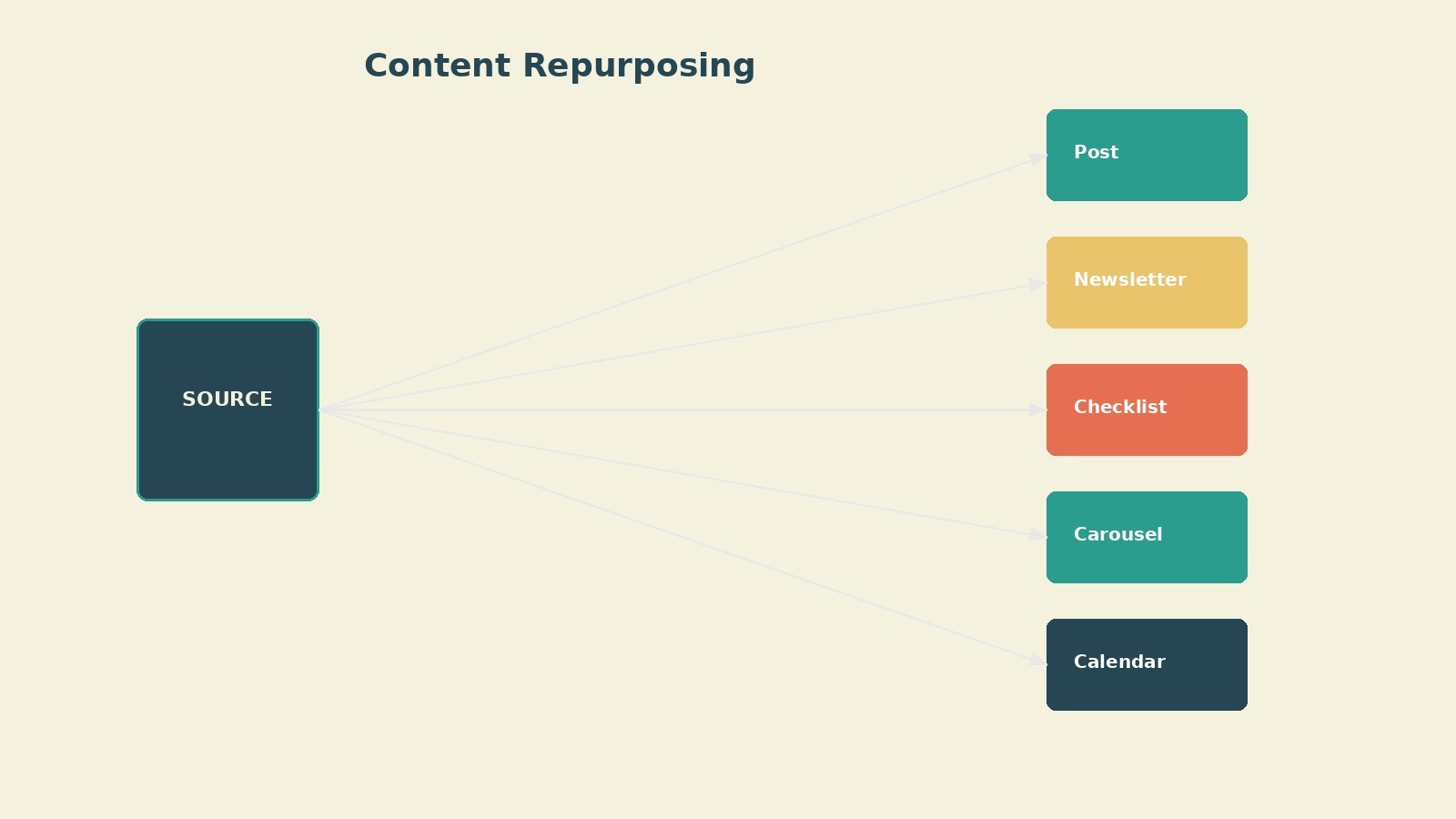
Here is where repurposing gets practical. Take one source and transform it into five platform-specific outputs. The worked example below uses a hypothetical 2,000-word guide on choosing a content niche as the source. Each output changes format, length, and structure to fit its platform.
Threads: Extract three key decision points from the guide. Each post covers one decision with a concrete example. Keep each post under 200 characters for readability. Use line breaks to create visual structure. LinkedIn: Reframe the guide's framework as a professional insight. Lead with a contrarian hook, then deliver the framework in a numbered list. End with a question to invite discussion. Newsletter: Pull the most common question the guide answers and format it as a reader Q and A. Keep it to 150 words with a direct answer. Carousel concept: Turn the guide's decision matrix into a visual swipe-through. Each slide covers one criterion with a one-line explanation. Checklist: Extract the guide's action items into a shareable checklist that works as a standalone post or a downloadable resource.
Notice that none of these are the same content in a different place. Each is a different format built from the same source material. That is the difference between repurposing and cross-posting. The source stays the same. The output transforms completely.
The key adaptation rule: match the format to the platform's native consumption pattern. On Threads, punchy conversational posts tend to read better. On LinkedIn, structured professional insights usually fit the feed. Newsletters favor direct answers. Carousels favor visual step-by-steps. When you fight the platform's format, repurposed content feels forced and gets ignored.
Threads and Text-First Repurposing
Threads deserves special attention because it is a text-first platform where repurposing works differently than on visual platforms. The most effective Threads repurposing extracts the sharpest insights from long-form sources and reframes them as standalone posts, not summaries. A blog section on common mistakes becomes a post like: "Three mistakes that keep showing up in niche selection" followed by the list. You are not linking back or saying "as I wrote in my blog." You are making the insight work on its own.
Serialization also works well on Threads. If a source has five key points, do not cram them into one post. Schedule them as five separate posts across the week. Each post should stand alone but together they tell a bigger story. This approach fits naturally into a content calendar and gives your audience multiple touchpoints with the same idea without overwhelming them.
For Threads specifically, watch the character limit and format for readability. Use line breaks, keep sentences short, and avoid walls of text. If you need a tool to draft and check your posts, the free Threads post creator lets you write, preview, and refine before you schedule. Good formatting is what separates a post that gets read from one that gets scrolled past.
Measuring What Repurposing Produces
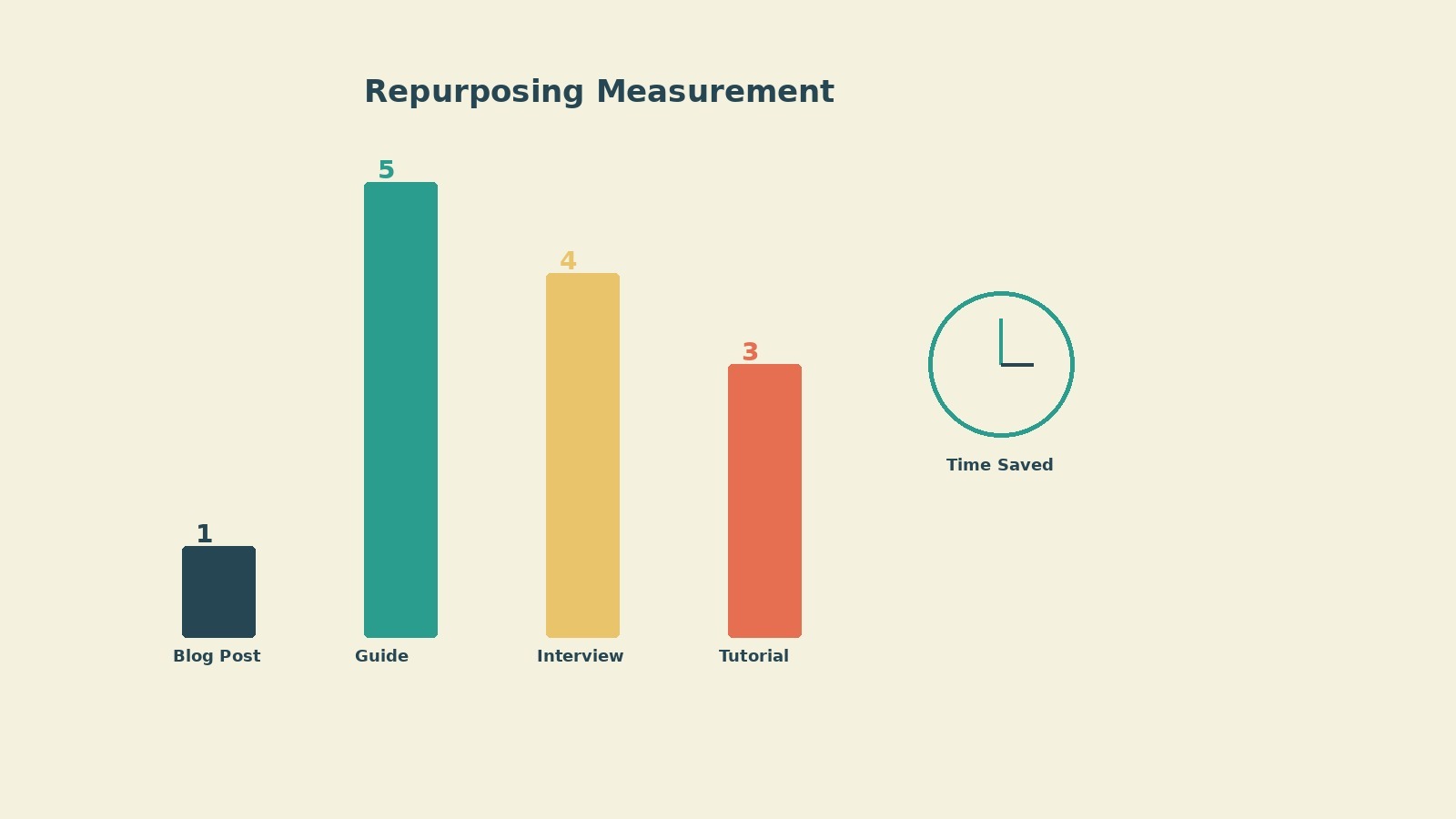
Repurposing is a production technique, not a growth hack. Measure it by what you actually control: how many distinct formats you ship per source, how much time you save compared to creating from scratch, and whether repurposed outputs perform at least as well as original posts on the same platform. If a repurposed Threads post gets similar engagement to your original Threads posts, repurposing is working. According to Sprout Social's research on social media content strategy, the majority of marketers plan to expand to more networks, which makes efficient content production increasingly important.
Avoid the trap of measuring repurposing by total reach across all platforms combined. That metric is inflated by platform differences and audience size, not by the quality of your repurposing. Instead, track format efficiency: how many usable outputs you get per source, and how long each output takes to produce. A useful benchmark is five usable outputs in about 30 minutes of adaptation time. A source that yields one output in an hour needs better mining or a lighter output set.
Over time, this measurement tells you which source types are worth repurposing and which formats produce the best return on your adaptation time. Use this data to refine your source selection and focus your effort where it pays off. This measurement approach connects to your broader content strategy: repurposing efficiency is one signal that tells you whether your overall system is working.
Action checklist
Use this as the practical next pass after reading the guide.
- +Audit your last 10 pieces of content and flag sources with 3 or more distinct takeaways.
- +For each flagged source, list 3 to 5 possible output formats by platform.
- +Set a 30-minute adaptation timer per source to prevent over-editing.
- +Schedule repurposed outputs in your calendar with clear platform labels.
- +After two weeks, compare repurposed post performance to original posts on each platform.
- +Drop source types that consistently produce weak derivatives.
Conclusion
Content repurposing multiplies the value of work you have already done. But it only works when you treat it as transformation, not duplication. Pick sources with real substance. Change the format for each platform. Measure by efficiency, not vanity metrics.
Done well, repurposing turns your best ideas into a content engine that produces more with less effort. Start with one strong source this week and see how many distinct formats you can build from it.