
What this guide is really about
Most social media approval advice assumes you have a marketing department, a legal team, and a compliance officer. If you run social for a two to five person team, an agency with a handful of clients, or a small brand where the founder still writes posts, that enterprise model will choke your output before it protects anything.
A social media approval workflow is the set of steps a post moves through from draft to published. That includes who reviews it, what they check, and when sign-off is actually required. The keyword is actually. Most posts do not need a formal review. The ones that do need it fast, not buried in a Slack thread.
This guide gives you a lightweight system built around risk tiers, clear post states, and realistic response times. It works whether you publish twice a week or forty times. It includes a Threads-specific application so you can connect approval to your publishing queue without adding a separate tool.
A social media approval workflow defines the steps a post moves through from draft to published: who reviews, what they check, and when sign-off is required. For small teams, the lightest effective system uses three risk tiers (routine posts that skip review, brand-sensitive posts needing one approver, and regulated posts needing documented sign-off) paired with five clear post states and simple response-time rules.
A three-tier risk model that tells you exactly which posts need review
A post-state workflow table with realistic response times
A small-team RACI so no one is confused about who approves what
A Threads-specific application that connects approval to your publishing queue
Most posts do not need formal review. A risk-tiered model routes only the posts that actually carry risk into an approval queue.
Five post states (draft, in review, approved, scheduled, published) are enough for any small team. More states add overhead without adding safety.
Set response-time expectations per tier. A 24-hour SLA for brand-sensitive posts prevents the bottleneck that kills most approval workflows.
A simple RACI with three roles (creator, reviewer, publisher) covers teams up to about five people without escalation chains.
Connect the workflow to your scheduling tool so approval status controls what can be queued. This closes the gap between review and publish.
What a Social Media Approval Workflow Is (and When You Actually Need One)
An approval workflow is the path a post travels from idea to published content. At minimum it includes a draft state, a review checkpoint, and a publish action. Enterprise systems add legal review, brand compliance, multi-level escalation, and audit trails. Those layers exist for a reason in regulated industries. They are overkill for a three-person team posting daily.
You need an approval workflow when more than one person touches your social media output and the cost of a bad post is real. That cost might be a brand inconsistency that confuses customers, a compliance violation in a regulated industry, a factual error that undermines trust, or a tone-deaf post during a sensitive moment. If you are a solo creator who writes and publishes everything yourself, you do not need a formal workflow. You need a pre-publish checklist.
The mistake most small teams make is importing the structure of an enterprise process without the staffing to support it. They create five review stages, assign them to people who have other jobs, and then watch the queue stall. Posts go out late or skip review entirely because the process is too heavy. The right approach is to match the workflow to your actual risk profile and your social media team workflow, not to a template designed for a fifty-person marketing org.
The Risk-Tiered Model: Stop Reviewing Everything the Same Way
The core idea is simple. Not every post carries the same risk, so not every post needs the same review. Sort your content into three tiers and apply review effort proportionally. This single change eliminates most approval bottlenecks because the majority of your posts fall into the routine tier and skip formal review entirely.
Tier 1 is routine content. These are standard posts that follow established formats, use approved templates, and do not make claims about products, pricing, competitors, or regulated topics. Examples include evergreen tips, behind-the-scenes glimpses, community questions, and reposted user content. These posts can go from draft to scheduled without a separate review step, as long as the creator follows your style guide.
Tier 2 is brand-sensitive content. These posts touch pricing, product claims, customer stories, promotions, partnerships, or anything that represents the brand publicly in a way that could be quoted or screenshotted. These need one reviewer (usually the brand owner, marketing lead, or founder) to check accuracy and tone before scheduling. Set a 24-hour SLA so the review does not become a bottleneck.
Tier 3 is regulated or high-stakes content. These posts involve compliance-sensitive industries (finance, health, legal), official announcements, crisis responses, or content that could trigger legal review. These need documented sign-off, meaning the approval is recorded with a timestamp and a name so you have an audit trail. If you operate in a regulated industry, you likely already know which posts fall here.
Post States and Response Times: Your Workflow Table
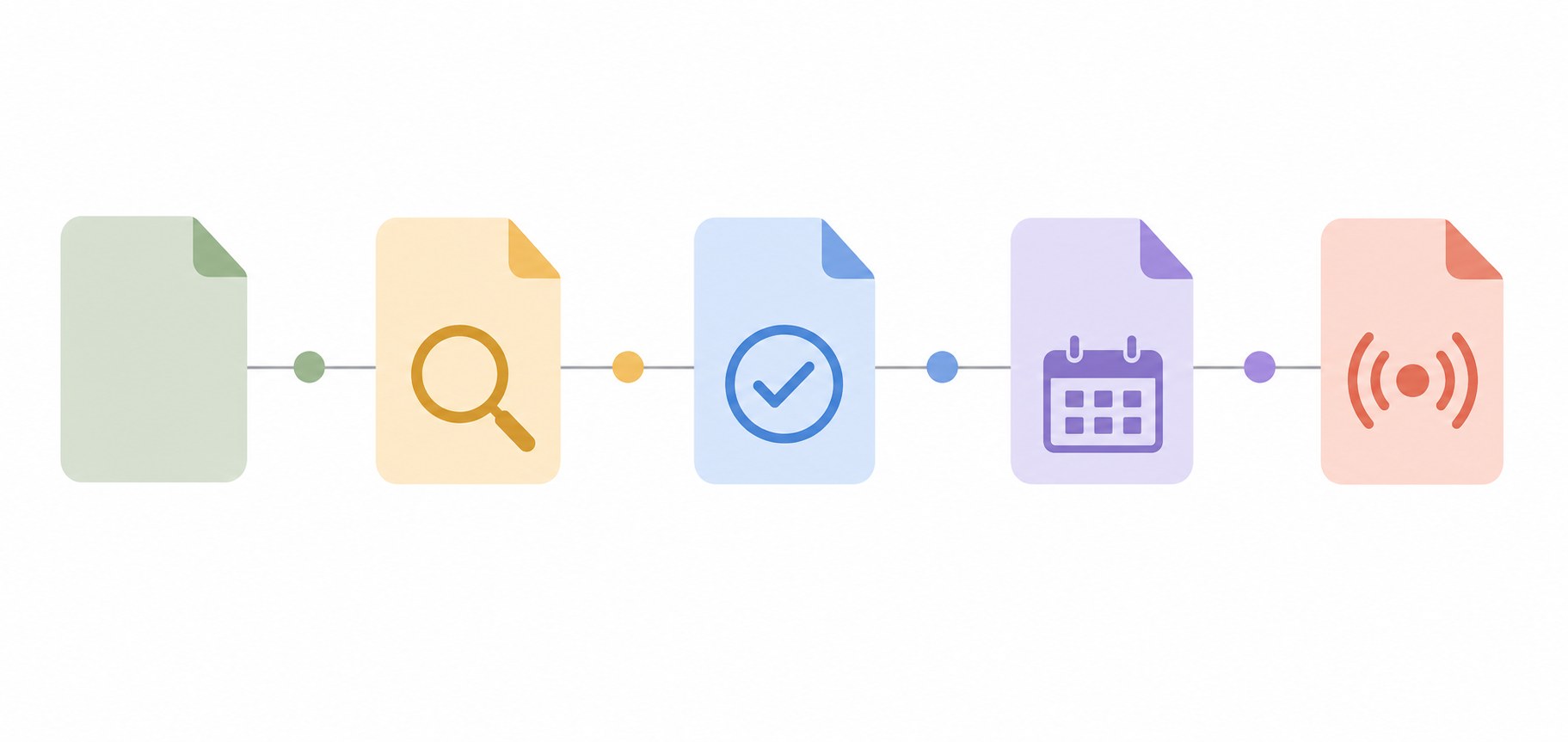
Every post moves through a sequence of states. For small teams, five states are enough. Adding more creates tracking overhead without improving safety. The goal is for anyone on the team to look at a post and know exactly where it stands and what happens next.
The five states are: Draft (creator is writing or editing), In Review (submitted for approval and waiting), Approved (cleared for scheduling), Scheduled (loaded into your publishing tool with a set time), and Published (live). Each state has an owner and an expected transition time so posts do not get stuck.
The workflow table below maps each state to its owner, the action that triggers the next state, and a realistic response time. Draft: Creator, write or edit, no SLA. In Review: Reviewer, approve or send back, Tier 2 within 24 hours and Tier 3 within 48 hours. Approved: Publisher, load into the scheduler, same day. Scheduled: Publisher, wait for publish time, per calendar. Published: Publisher, monitor live replies and errors, same day. Response times are the part most teams skip, and they are the reason queues stall. Without an SLA, a post sits in review for a week because no one knows it is overdue. A clear approval process for social posts depends on these time expectations as much as on the review itself.
Treating every post as needing the same level of review. Route by risk tier so routine content flows and risky content gets real attention.
Setting no response-time expectation. Without an SLA, reviews drift and the queue becomes a graveyard.
Making the same person Creator and Reviewer. Self-review adds delay without catching the errors a second pair of eyes finds.
Building a five-stage process before you have had a single review failure. Start with three tiers and add structure only when something breaks.
Keeping approval in a separate tool from scheduling. If approved posts are not connected to your publishing queue, the workflow will eventually be bypassed.
Who Approves What: A Simple RACI for Small Teams
A RACI matrix maps who is Responsible (does the work), Accountable (owns the outcome), Consulted (gives input), and Informed (needs to know). For social media approval, you can simplify to three roles that cover teams up to about five people without escalation chains.
The Creator writes the post, selects assets, assigns the risk tier, and moves it to In Review if it is Tier 2 or Tier 3. The Creator is Responsible for the draft. The Reviewer checks brand-sensitive or high-stakes posts against the approval checklist and either approves or sends back with notes. The Reviewer is Accountable for Tier 2 and Tier 3 sign-off. The Publisher schedules approved posts and monitors the live queue. In a two-person team, one person is Creator and Publisher, and the other is Reviewer.
The key question is who should be Reviewer. It should be the person whose judgment you trust on brand and accuracy, not necessarily the most senior person. For many small teams that is the founder, the marketing lead, or a designated senior creator. Avoid making the Reviewer role a rotating assignment. Consistency in review standards matters more than distributing the workload.

Plugging the Workflow Into Your Threads Publishing Queue
An approval workflow that lives in a separate document from your publishing tool will eventually break down. Posts get approved in one place and scheduled in another, and the connection is held together by memory and Slack messages. The fix is to connect approval status to your scheduling queue so only approved posts can be queued for publishing.
If you use a scheduling tool that supports publishing via the official Threads API, you can enforce this with a simple rule: posts must carry an Approved status before they enter the scheduling queue. This closes the gap between review and publish without adding a separate approval tool. The scheduling workflow handles the mechanics of timing and publishing, while the approval status controls access to the queue.
For Threads specifically, this matters because the platform rewards consistency. A workflow that delays routine posts by two days for unnecessary review hurts your presence. Route routine posts straight to scheduling, hold brand-sensitive posts for a fast review, and reserve documented sign-off for the posts that actually carry compliance or reputational risk. You can draft the routine and brand-sensitive posts faster using a purpose-built tool like the Free Threads Post Creator, then apply the tier rules before scheduling.
When Formal Approval Makes Things Worse
Approval workflows have a failure mode that nobody warns you about. Once you create a review step, people start routing everything through it, even posts that do not need review. The queue grows, response times stretch, and publishing slows. Eventually the team starts bypassing the workflow to meet deadlines, which means the riskiest posts get the least scrutiny.
The signal that your workflow is too heavy is simple: routine posts sit in review for more than a day. If your Tier 1 content is waiting for sign-off, either your tier definitions are wrong or your Reviewer is being asked to do too much. The fix is to tighten the tier rules so routine posts skip review, and to give the Reviewer authority to approve Tier 2 posts asynchronously without a meeting.
Another warning sign is when the same person is both Creator and Reviewer for the same post. If you are reviewing your own work, the review adds time without adding safety. In that case, either assign review to a different person or drop the review step and use a pre-publish checklist instead. A checklist that the Creator runs themselves is faster and catches most accuracy errors, plus basic formatting and structure that get read.
Rollout: Start Small and Tighten Only What Breaks
If you are building an approval workflow from scratch, start with the minimum viable version. Define your three risk tiers, assign one Reviewer, and set a 24-hour SLA for Tier 2 posts. Do not build a tool, buy software, or create a five-stage process on day one. Run the lightweight version for two weeks and see what breaks.
After two weeks, check three things. First, are Tier 2 posts getting reviewed within the SLA? If not, either the tier is too broad or the Reviewer needs help. Second, are any published posts generating errors, complaints, or brand issues that the workflow should have caught? If yes, those post types belong in a higher tier. Third, is routine content still flowing to scheduling without friction? If routine posts are stalling, tighten the tier definitions.
The goal is a workflow that evolves with your team. Most small teams need nothing more than the three-tier model, a shared calendar with status labels, and a Reviewer who responds within a day. After you add review gates, use Threads analytics to check whether publishing pace and quality still hold. Add structure only when a real failure shows you where the gap is. A workflow that prevents problems you have never had is just bureaucracy.
Action checklist
Use this as the practical next pass after reading the guide.
- +Define your three risk tiers with concrete examples of what falls into each
- +Assign one Reviewer and give them authority to approve Tier 2 posts asynchronously
- +Set a 24-hour SLA for Tier 2 and a 48-hour SLA for Tier 3 sign-off
- +Label every post in your calendar with its current state (Draft, In Review, Approved, Scheduled, Published)
- +Enforce a rule that only Approved posts enter your scheduling queue
- +Review the workflow after two weeks and adjust tier boundaries based on what actually broke

Conclusion
A good social media approval workflow protects your brand without punishing your publishing cadence. The three-tier risk model is the foundation: route routine posts straight to scheduling, hold brand-sensitive posts for a fast single review, and reserve documented sign-off for the content that genuinely carries compliance or reputational risk.
Start with the minimum version. Three tiers, one Reviewer, five post states, and a 24-hour SLA. Run it for two weeks, watch what breaks, and tighten only the gaps that real failures expose. A workflow that prevents problems you have never had is overhead you do not need.