
What this guide is really about
Most advice about selling digital products starts with a list of product ideas: ebooks, courses, templates, presets. Pick one, set up a storefront, and wait. That advice works fine for people who already have an audience that trusts them. It quietly fails for writers on Threads, X, or LinkedIn whose audience follows them for their words, not for a product catalog.
The listicle approach reverses the actual order of a working sale. People who follow a text creator do not buy because a product type is trending. They buy because a specific person has repeatedly solved a specific problem in public, and the product is the natural next step. The product choice comes after the audience evidence, not before it.
This guide flips the model. You will start with what your audience already asks you about, build a three-layer funnel that matches how text platforms distribute posts, run real numbers on what a checkout actually costs at small volume, and learn the Threads-specific mechanics that decide whether your link ever gets clicked.
Pick your first digital product from questions your audience already asks, not from a trending list. Build a three-layer funnel: discovery posts that earn reach, depth content that builds trust, and one offer post with a single link. Run the fee math before launch: on $580 in monthly sales, Gumroad leaves you $512 and Lemon Squeezy $541. Then track link clicks weekly, because revenue moves too slowly to steer by.
Choose a product your audience has already asked for
Build a three-layer funnel that fits text platforms
Know your real per-sale costs before you launch
Launch without turning your feed into ad space
Product selection is audience evidence, not product-type research. Your replies, DMs, and repeated questions are the demand data.
A text funnel needs three layers: discovery posts for strangers, depth content for consideration, and a single offer entry point. Most creators only have layer one.
At small volume, merchant-of-record platforms win on simplicity: Gumroad charges 10% plus $0.50 per direct sale and Lemon Squeezy 5% plus 50 cents, both including global sales tax handling.
A launch is a two-week content sequence, not one announcement post. Plan for several offer mentions across the window, because any single post usually reaches only a fraction of followers.
Track link clicks, offer mentions, and reply sentiment weekly. Revenue is a lagging indicator that moves too slowly to steer a young funnel.
Why Text Audiences Buy Differently
A text-first audience on Threads, X, or LinkedIn has a different relationship with you than a YouTube subscriber or a TikTok follower. They followed your reasoning, not your production quality. They have read dozens of your posts and formed a judgment about how you think. That is an advantage: trust is already partially built before you ever mention a product.
The disadvantage is that text platforms give you almost no natural sales surface. There is no storefront tab, no product shelf, no video end screen. A follower has to want to leave the feed, click your profile, find your link, and complete a checkout. Every extra step in that chain loses people, so the system in this guide is designed to reduce that chain to its shortest honest form.
There is also a rhythm difference. Feed algorithms surface your post to a fraction of your followers at any given time, and a text post often fades within a day or two. One launch post reaches far fewer people than a sustained sequence. Treating a launch like a one-day event rather than a process is a frequent reason text creators conclude that their audience does not buy.
Step 1: Choose the Product Your Audience Already Asks For
Reverse the listicle. Before considering what to sell, collect evidence about what your specific audience struggles with. Open a document and pull from four sources: recurring questions in your replies, questions in DMs, the posts of yours that got saved or heavily quoted, and the requests people make directly, like asking whether you have a template or course for something you explained. Two weeks of honest collection usually surfaces three to five candidate problems.
Then apply a fit filter. A problem is product-worthy when it is specific enough to solve in a downloadable artifact, recurring enough that new followers hit it monthly, and aligned with what you genuinely know. A writer who constantly explains their posting workflow in replies has template evidence. A writer whose posts are interesting but whose replies are all just agreement has no product evidence yet, and should keep collecting before building anything.
Match the format to the evidence. Repeated how-to questions map to a guide or mini-course. Requests for your templates map to a template pack. People asking to go deeper map to a paid newsletter or community. People asking you to just do it for them map to a service, not a product, which is a different business. The format follows the request, never the reverse. If you are still choosing among income paths rather than locking a product, start with the wider make money on Threads overview, then come back here for the product build. And if you plan to earn commissions on other people's offers instead of selling your own, that is a separate system covered in the Threads for affiliate marketing guide. If you want a faster way to draft the kind of posts that surface product questions, the free Threads post creator on JoltSage can structure a week of drafts in one sitting.
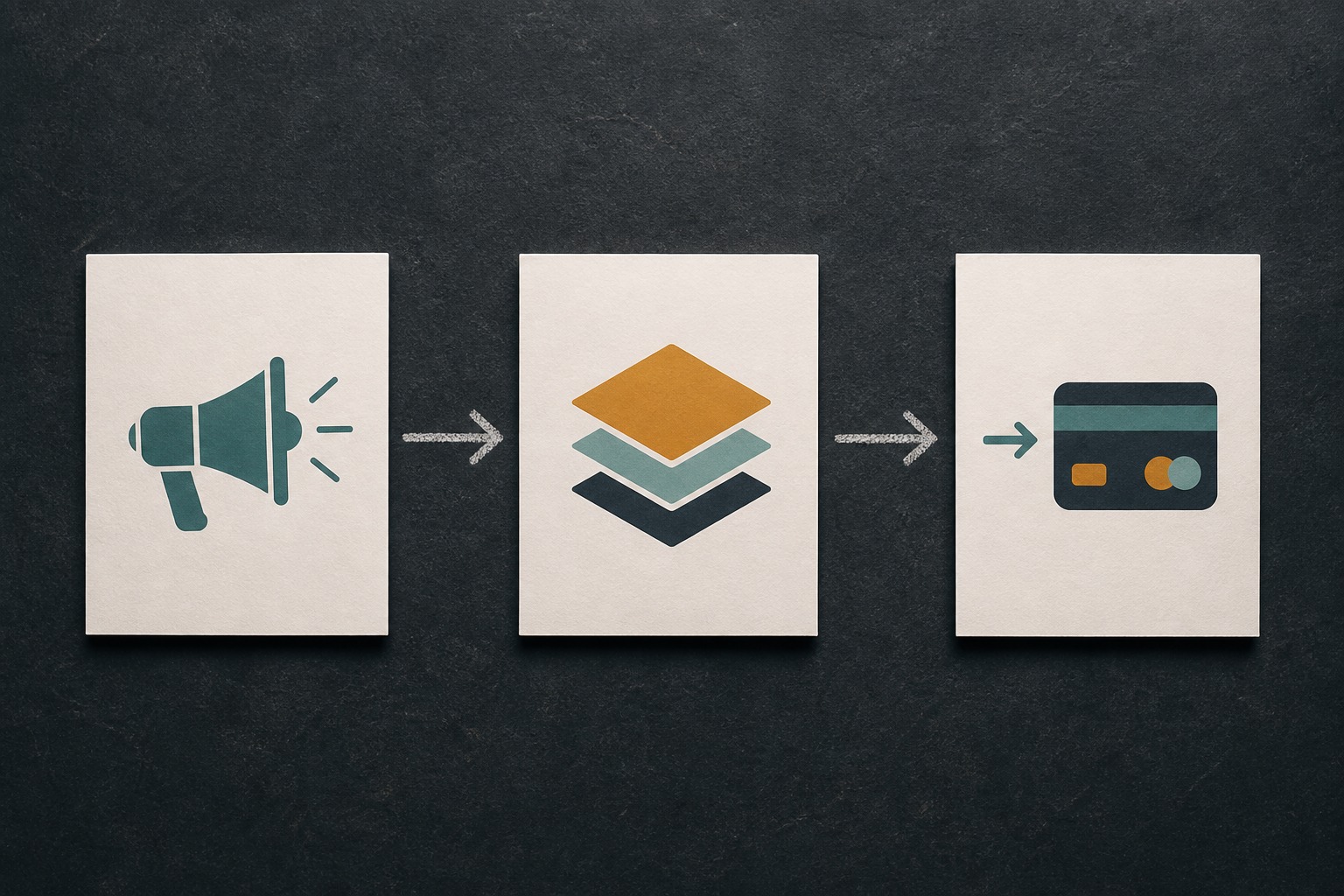
Step 2: Build the Three-Layer Funnel
Most creators have layer one only: individual posts that occasionally reach strangers. A working text funnel has three layers, each with a distinct job. Layer one is discovery. These are your best standalone posts, the ones that earn reach on their own merit and pull new readers to your profile. They should never mention the product. Their only job is to make a stranger think this person thinks clearly.
Layer two is depth. This is where you go visibly deeper on the exact problem your product solves, in public, for free. If you sell a content calendar template, layer two is posts that walk through how you plan a real week, including the messy parts. Depth posts filter for the readers who care about that problem, and they pre-solve enough of it to build real trust. Aim for a ratio of roughly five depth posts per offer mention so your feed never reads as a catalog.
Layer three is the offer. One pinned or periodically repeated post that states plainly what the product is, who it is for, what it costs, and the single link. The offer post should be rewriteable so you can test different framings. The funnel works as a chain: discovery posts feed profile visits, your profile carries the link, depth posts supply the trust, and the offer post gives the final nudge. Remove any layer and the chain breaks at a predictable point.
Picking the product from a trending list instead of from questions your audience already asks, then wondering why nobody buys.
Posting the offer once and concluding the audience is not buyers, when most followers never saw the single mention.
Choosing a checkout platform without reading the fee structure, then losing 30% to a marketplace fee you did not expect.
Selling directly on Stripe to save fees before you have volume, and discovering you are now maintaining a file delivery and tax setup yourself.
Judging the funnel on weekly revenue swings instead of the input chain of profile visits, clicks, and checkout views.
Step 3: Run the Real Fee Math Before You Launch
Creators routinely pick a checkout platform by brand familiarity and discover the cost structure only after the first payout. The numbers below are from each platform's official pricing page as of August 2026, computed on a modest but realistic early goal: 20 sales a month at $29, or $580 of monthly revenue. Processor fees from PayPal or Stripe still apply on Payhip, so those are added where relevant.
According to Gumroad's official pricing, direct sales carry a 10% fee plus $0.50 per transaction, so 20 sales cost $68 in fees and you keep $512. Sales that arrive through Gumroad's Discover marketplace carry 30%, which is worth knowing before you count on marketplace traffic. Gumroad has operated as a merchant of record since January 2025, which means it handles global sales tax collection and remittance for you. Lemon Squeezy's pricing page lists 5% plus 50 cents per transaction, so the same 20 sales cost $39 and you keep $541, also with merchant-of-record tax handling. Payhip's pricing shows a free plan with a 5% platform fee while PayPal or Stripe processing still applies. Using Stripe's published 2.9% plus $0.30 as the processor example, that stack totals about $52 on the same volume and leaves about $528, with Payhip collecting and remitting EU VAT and UK VAT on your behalf.
The cheapest raw option is selling directly through Stripe's published fees of 2.9% plus $0.30 per domestic card transaction, which costs about $23 on the same volume and keeps $557. But that comparison is misleading for most solo creators, because Stripe alone does not deliver files, handle EU VAT, or manage refunds and license keys. You would build or buy those systems yourself. The honest way to frame the choice: merchant-of-record platforms charge roughly $16 to $45 more per month at this volume in exchange for tax compliance and zero maintenance. That trade becomes clearly unfavorable only at high volume, which is a good problem to revisit later, not now.

Step 4: Launch Without Spamming Your Feed
A launch on a text platform is a two-week content sequence, not a single announcement. The sequence has three beats. Week one is depth week: five to seven posts that go deep on the problem your product solves, with no offer mention, ending with one post that asks readers what their biggest version of that problem is. The replies to that question become both social proof material and product feedback.
Week two is offer week. One clean launch post on day one stating what, who, price, link. Then alternate: a depth post, a testimonial or reader-quote post if you have honest ones, a behind-the-scenes post about why you built it, and a final-day recap post. Plan several offer mentions across the two weeks rather than one announcement. That is not spam. Because feeds only show your posts to a fraction of followers at a time, most of your audience sees any given offer mention zero or one times.
Two guardrails keep the sequence honest. First, every offer post must be useful even to someone who never buys: it should teach the framework, tell the story, or show the workflow, with the product as the shortcut at the end. Second, reply to every buyer and every question personally during the launch window. On a text platform the replies under your offer post are often what convinces the silent reader, not the post itself. For a structured starting point, the Threads content calendar template approach of planning a full week in one sitting fits launch sequences well.
Step 5: Measure Inputs, Not Wishful Revenue
New funnels die from bad measurement more than from bad products. Revenue at small volume is noise: one week of $145 and one week of $29 contain almost no signal. What carries signal is the chain of inputs that precedes revenue: profile visits after discovery posts, link clicks from your profile or offer posts, checkout page visits, and the conversion between checkout views and purchases.
Set up the simplest honest tracking you can. Use one consistent link so your platform's analytics show a single source. Record three numbers weekly: offer mentions posted, total link clicks, and sales. The ratio between clicks and sales tells you whether the problem is traffic (few clicks) or the offer page (clicks but no sales). Those are completely different fixes, and confusing them wastes months.
Read those numbers the way you would read any lagging versus leading indicator split. If clicks are flat, your discovery and depth layers need work. If clicks are fine but sales are not, your pricing, promise, or product page needs work. And if someone asks in replies whether the product is right for their situation, answering publicly often converts lurkers better than another offer post would. For a fuller framework on which numbers deserve attention, the Threads analytics guide covers which metrics actually predict improvement.
Threads Mechanics That Affect Sales
Threads gives you a small set of surfaces to work with, and each one matters. Where multi-link bios are available, you can add up to five profile links, so reserve one clearly labeled slot for the offer and use the pinned post for either your best depth post or the offer post during launch windows. Topic tags can help problem-aware browsers find a post beyond your follower graph, but treat tags as a discovery assist, not a ranking guarantee. And because Threads posts can lose positioning in fast-moving feeds, schedule offer posts for the windows when your audience is actually active rather than posting blind.
Link behavior deserves special care. A bare link in a post body may get less distribution than a plain text post on some text platforms, according to creator reports rather than a published platform rule, so a common pattern is to put the link in a reply under your own offer post rather than in the post body itself. That also keeps the post body copyable and screenshot-friendly, which can help shares. Test both placements with your audience and keep whichever produces more link clicks over time.
The compounding play is scheduling. A launch sequence planned once and scheduled across two weeks survives your busy days, and the offer post can be scheduled into peak windows without you being online. This is exactly the workflow a scheduler exists for: if you want the full mechanics of scheduled publishing, the how to schedule Threads posts guide walks through native and API workflows end to end.
Action checklist
Use this as the practical next pass after reading the guide.
- +Collect two weeks of audience questions from replies and DMs into one document
- +Pick one product format that matches the most repeated request, not the most exciting idea
- +Draft five depth posts that solve parts of the problem in public before mentioning any offer
- +Compute your break-even price from your platform's fee page at your expected volume
- +Write one clear offer post with product, audience, price, and a single link
- +Schedule the two-week launch sequence and track offer mentions, link clicks, and sales weekly

Conclusion
Selling digital products to a text-first audience is not a listicle decision followed by a storefront signup. It is an evidence decision, a funnel design, a fee calculation, and a two-week launch sequence, executed in that order.
Start smaller than feels natural: one product, one link, one funnel chain, measured weekly on inputs. The writers who make this work are rarely the ones with the best product. They are the ones who noticed what their audience kept asking for and built the honest next step.
If you take one action from this guide, make it the evidence collection this week. Every other step gets easier and more accurate once the audience has already told you what to build.