
What this guide is really about
You decided to leave X. The hard part is not signing up for Threads, which takes minutes. The hard part is moving without abandoning the audience, content habits, and search visibility you spent years building. Creators who just delete and restart tend to arrive on Threads talking to nobody, then conclude the platform doesn't work.
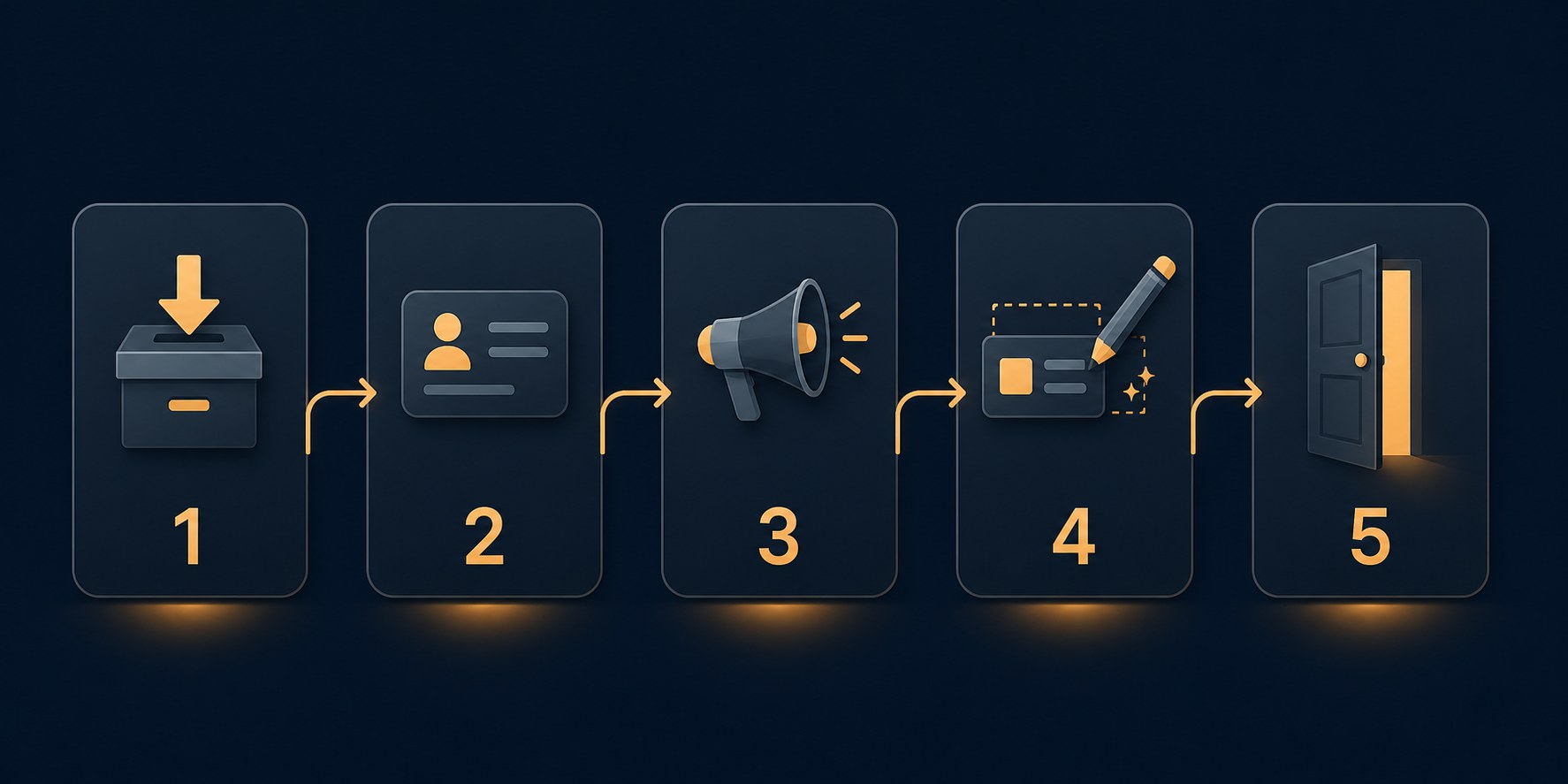
This checklist walks the migration in the order that protects what you built: export first, rebuild second, announce third, adapt fourth, and only then retire the old account. Every phase has a concrete deliverable, so you always know whether you're ready for the next one.
You cannot transfer a following between platforms. Export your X archive first, complete your Threads profile, announce the move on X several times before leaving, adapt posts to Threads instead of cloning them, and run both accounts for a few weeks. Deactivate X last: if you stay deactivated for 30 days, X permanently deletes the account.
Nothing moves automatically. No tool transfers your followers, DMs, or post history from X to Threads. What transfers is whatever you export and rebuild yourself.
Export your X archive before touching anything else. The archive holds your posts, media, and follower data, and deactivation permanently deletes the account after 30 days.
In April 2025 Meta confirmed it was testing a following-list import on Threads so you can find creators you already follow on X. It matches popular accounts first and does not move your own audience.
Announce the move on X multiple times across several weeks. One goodbye post reaches a small slice of your audience because feeds move on within hours.
Adapt rather than clone. Threads gives you 500 characters, free editing, and one topic tag per post, so a straight copy of your X style wastes the format.
What Actually Transfers (and What Doesn't)
Start with honest expectations, because migration tools market themselves harder than they deliver. Your X post history, direct messages, lists, and bookmark counts do not transfer to Threads. Your X verified badge does not carry over, and neither does your follower count. A Threads badge comes from Meta Verified on Instagram when that Instagram account and Threads share the same Accounts Center. What you can take is your archive: X lets you download an archive of your data that contains your posts, media, and account information, which becomes your source material for rebuilding.
One partial shortcut exists. In April 2025 Meta said it was testing a way for you to upload the list of people you follow on other apps to Threads, starting with X. You download your following list from X and Threads attempts to match those accounts. Reporting on that test said it works for popular creators first, so expect partial matches rather than a full rebuild of your following graph. Treat it as a convenience for the accounts you read, not a way to carry your audience. There is still no documented way to import the people who follow you.
For your own audience, there is no import button anywhere. The people who followed you on X have to choose to follow you on Threads. That's why the rest of this checklist focuses on making that choice easy: they need to know where you're going, recognize you when you arrive, and find content worth following all over again.
Phase 1: Export Everything Before You Touch Settings
Deactivation is the most dangerous button in this migration, so it comes last in your workflow, not first. X deletes your account permanently if you stay deactivated for 30 days. Every draft, DM, and historical post goes with it. Export first and you remove the time pressure entirely.
Request your archive from X by opening Settings and privacy, choosing Your account, then selecting the option to download an archive of your data. Confirm your password, verify with the code X sends, then request the file. X says it may take a few days to prepare; you get an email and in-app notice when it is ready.
Sort the archive once it arrives. Separate evergreen posts worth adapting from time-sensitive chatter not worth moving. This filtered list becomes the seed of your first month on Threads, so you're not starting from a blank page. Skipping this step leaves you drafting from memory in week one, which reads as aimless to new visitors checking your profile.
Phase 2: Rebuild Your Threads Profile So People Recognize You
Your first audience on Threads is people clicking over from your announcement posts. If your profile looks new and empty, they hesitate to follow. Fill it before announcing anything: same profile photo people associate with you, a bio that matches your X positioning, and links to wherever you sell or publish. Threads supports up to five links in your bio. Meta also added profile topic tags (up to ten) so related conversations sit near your name.
Write your first five to ten posts before you promote the account. A visitor who finds two posts and silence leaves without following. Use your archive shortlist from Phase 1: adapt your strongest evergreen material to Threads' format rather than reposting it word for word. Pin one post that explains who you are and what you post about, so a visitor who lands on a young profile has a place to start.
If you want a systematic pass at this, our Threads profile optimization guide walks each field with a before-and-after example. The short version: optimize for the visitor deciding in five seconds whether you're worth following, not for completeness.
Deactivating X in week one. You lose the archive window, the redirect value of your old bio, and the announcement channel that carries your audience over. Deactivation is the final step, not the opening move.
Announcing the move once and leaving. A single post reaches only the slice of followers who happen to be in the feed that day. Repeated, varied notices across two to three weeks give late visitors more than one chance to see the handle.
Cloning X posts word for word. Threads' 500 characters, editing, and reply-driven discovery reward posts written for the format. Copied posts read as recycled to people who follow both accounts.
Arriving with an empty profile. New visitors check your bio, pinned post, and recent posts before following. Fill all three before promoting the account anywhere.
Judging Threads after five days. Distribution on a new account builds through replies and consistency over weeks. Quitting during calibration tells you nothing about the platform.
Phase 3: Bring Your Audience Over With Repeated Notices
One farewell post reaches a fraction of your followers. Feeds move on within hours, and plenty of your audience logs in weekly, not daily. Plan three to five announcement posts spread across two to three weeks, each written differently so they don't read as spam. Vary the frame: the honest reason you're moving, what you'll still post on X, what happens after you stop, and a final-week reminder with your Threads handle in the first line.
Make each notice do one job: get your handle seen and remembered. Put the handle at the start of the post rather than the end, because truncated previews hide the tail. A workable pattern: "I'm now posting daily on Threads. Same topics, fewer distractions. Find me at @yourhandle." Keep it that concrete. Vague "following me elsewhere" posts convert poorly because they ask the reader to do detective work.
Use off-platform channels as the safety net. Your newsletter, website, and anywhere else you own the contact is where migration announcements survive algorithm decay. If someone misses every X post, a newsletter or site note still sits in a channel you own. Use that as backup, not as a claimed recovery rate.

Phase 4: Adapt Your Content Instead of Cloning It
This page assumes you already chose Threads. Do not rerun the platform bakeoff here. Use 500 characters, free editing, and one topic tag per post as native writing constraints while you adapt the archive, and leave the format and cost comparison to the Threads vs X decision framework.
Adapt your archive shortlist with the format in mind. A 280-character X post often expands naturally into a 400-character Threads post with one extra sentence of context or a clearer question at the end. Serialization works well too: a long take you'd compress into a thread on X can become two or three standalone Threads posts across a week, each carrying its own hook. Our formatting guide covers line breaks, structure, and readability specifics if you want the mechanics.
Dual-running is for announcements and a reduced X presence, not a second copy of every Threads post. If a scheduler dumps the same caption both ways, stop and rewrite the hook. Identical cross posting is the failure mode; keep the first line and the ask native, and send identical-vs-adapt decisions to the cross-posting article rather than restating that framework here.
Phase 5: Run Both Accounts, Measure, Then Retire X on Your Terms
Set a dual-running window of four to six weeks rather than an abrupt exit. During the window, keep a reduced X presence (one or two posts a week plus replies) so the account stays alive and your notices keep surfacing. The goal is a soft landing on Threads, not simultaneous full output on both platforms, which is how creators burn out mid-migration.
Use the window to finish announcements and see whether click-overs follow. Track Threads follower growth, replies per post, and profile visits from X if you can tag them. This is an audience-hand-off window, not a same-content A/B of the two apps. If replies and follows stay near zero after six weeks of posting and replying, the next lever is adaptation and reply activity, which the reply-first growth strategy addresses directly.
Only when you're settled do you deactivate X, knowing the 30-day deletion clock starts then. Post the final goodbye, change your X display name and bio to point at your Threads handle, pin the goodbye, and deactivate. The bio pointer matters: people checking your old handle months later find directions instead of a dead end. And if the handle itself matters for your brand, weigh the risk that releasing it makes impersonation easier before you walk away.
The First Month on Threads: What to Expect Honestly
Expect a smaller, quieter start than you had on X. A fraction of your audience moves with you, and Threads' recommendation system needs time to learn who should see your posts. Meta announced Threads reached 500 million monthly active users in June 2026, so the audience exists, but distribution on a young account comes mostly from replies and consistent posting, not from your reputation carrying over.
Spend the reply budget deliberately in month one. Reply to accounts in your niche daily, answer every reply you receive, and post three to five times a week at minimum while the system calibrates. This is also the window to test posting frequency rather than copying someone else's magic number; our posting frequency test protocol shows how to find your cadence with your own data.
Keep expectations anchored to inputs you control. You can't control reach on any platform, including this one. You can control posts shipped, replies written, and profile conversion. Track those three inputs through month one so you are judging work you actually did, and the free Threads post creator can shorten drafting time while you do the rest by hand.
Action checklist
Use this as the practical next pass after reading the guide.
- +Request your X archive download today; it can take days to prepare.
- +Sort archive posts into an evergreen shortlist worth adapting (aim for 20 to 30).
- +Complete your Threads profile: photo, bio, up to five links, topic tags, pinned intro post.
- +Publish five to ten Threads posts before announcing anything on X.
- +Run three to five varied announcement posts on X across two to three weeks, handle in the first line, plus one newsletter or site mention.
- +After four to six weeks, check Threads growth and reply quality, then finalize: goodbye post, bio pointer, deactivate knowing the 30-day deletion clock starts.
Conclusion
A migration that protects your audience runs in one direction: export, rebuild, announce, adapt, run both, then retire. Each phase hands something to the next one. The archive feeds your first month of posts, the completed profile converts the traffic your announcements send, and the dual-running window gives you real data before you close the door.
Move at the pace of your audience, not at the pace of your frustration with X. The creators who land well on Threads are usually the ones who gave their followers three or four chances to notice the move and something worth following when they arrived.