
What this guide is really about
You finished the project. The client messaged to say the work was exactly what they needed, maybe the best they've worked with. You typed a quick thanks, the conversation scrolled away, and the strongest proof you'll ever get vanished into a chat window.
That's not a courage problem. It's a capture problem. Happy clients hand you proof all the time, in thank-you messages, in renewal notes, in offhand DM compliments, and most of it evaporates because nothing is set up to catch it.
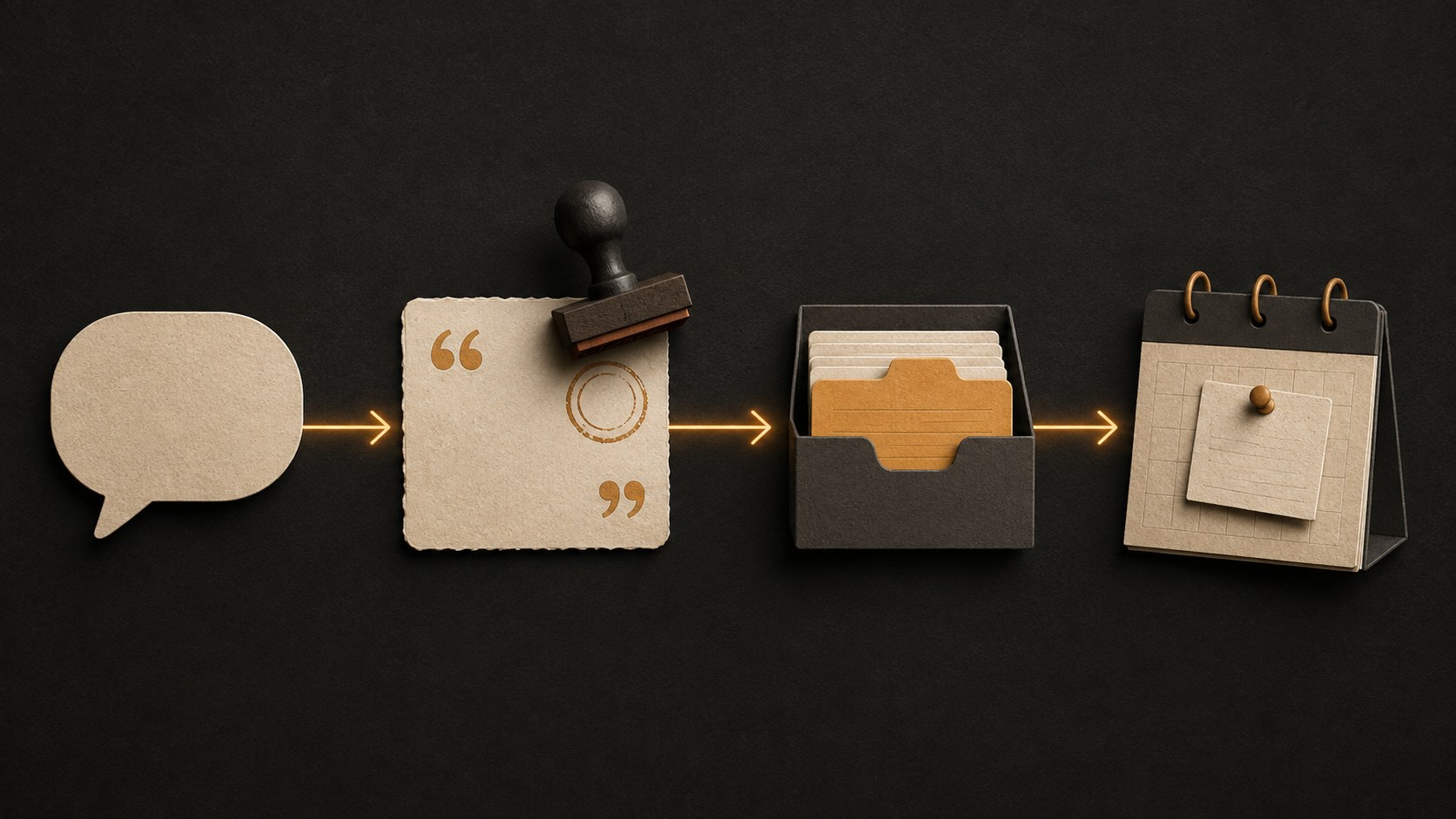
The fix is a capture-to-post system: four moments when praise is easiest to collect, scripts that make asking painless, permission rules that keep you honest, and a simple bank that turns one quote into months of content.
Getting testimonials is a capture problem, not a courage problem. Ask at the moment of delight: right after delivery, at a results check-in, or when praise lands in your DMs. Make the ask specific with three guided questions, get written permission, save every quote to a testimonial bank, and repurpose the best ones into posts.
Capture praise inside four windows: the delivery thank-you, the results check-in, the unprompted DM compliment, and the renewal moment.
Ask one specific question instead of a blank-page request so saying yes takes your client about two minutes.
Get written permission covering name, title, and public use before any testimonial leaves your files.
Store every quote in a dated testimonial bank and review it quarterly to spot services with no proof.
Why Testimonials Outperform Your Own Claims
You can say you're good, or someone else can say it for you. Only one of those survives contact with a skeptical reader. When a stranger lands on your profile, your own claims read as marketing, while a named client describing real work reads as evidence.
The numbers back that up. The BrightLocal Local Consumer Review Survey found that 97% of consumers lean on reviews to guide purchase decisions, and 93% have made a purchase after reading reviews. People don't just tolerate peer proof, they look for it before they buy.
There's also an asymmetry working in your favor. Consumers are more likely to write about positive experiences (60%) than negative ones (29%), according to the same survey. Your happy clients aren't racing to complain about you. They're quietly willing to praise you, if someone makes it easy. If you also gather proof from your audience instead of clients, a user-generated content strategy covers that side of social proof.
The Four Capture Windows
Testimonial collection fails when it's a one-time event, a big ask sent months after the work went cold. It works when it's a habit attached to moments that already happen in your workflow. Four windows are where praise is easiest to collect, and each one needs a slightly different move. The first window is the thank-you message right after delivery. Praise peaks when results are fresh, so the moment a client says the work landed well, reply with a soft ask like 'That means a lot. Would you be open to a quick testimonial I can quote from?' The emotion is already in the room. You're just channeling it.
The second window is the results check-in, two to four weeks after delivery. By then the client has seen how the work performs in the real world, and a short 'how's it going' message gives them a natural place to report back. That's when specifics appear: the time saved, the problem solved, the thing that surprised them. The third window is the unprompted compliment. Someone replies to your post or slides into your DMs to say your thread helped them or your service nailed something. Don't just screenshot it. Ask first: 'Love that, thank you. Any chance I could quote this?'
The fourth window is the renewal or repeat purchase. A client coming back has already voted with their wallet, which makes their endorsement unusually strong. At renewal time, try: 'Glad we're working together again. Would you share a sentence or two on what keeps you coming back?'
Notice the pattern across all four: the compliment already exists, and your only job is to catch it before it scrolls away. Compliments expire. Systems do not.
How to Ask: The Anatomy of a Request That Gets Answered
Most testimonial requests die because they're vague. 'Could you write me a testimonial?' hands your client a blank page with no deadline, and blank pages lose to everything else in their inbox. A request that gets answered does four things: names the specific win, asks one concrete question, makes saying yes take about two minutes, and offers a graceful out.
The out matters more than you'd think. 'No pressure either way, seriously' removes the awkwardness, and removing awkwardness is most of the game. Being asked is normal anyway: 78% of consumers were asked to leave a review in the last 12 months, per BrightLocal's 2026 survey, and 28% now say they'll always write one when asked, up from 16% the year before. Asking is common. Asking well is rare, and the same skill powers how to generate leads on Threads without spamming anyone, where the move is a specific, low-pressure ask rather than a pitch.
Here are four templates to copy and adapt. Keep the structure, swap in your specifics. Email script after delivery: 'Hi [name], so glad the [deliverable] landed well. Would you be open to a short testimonial I can use on my site and in posts? One question if yes: what result mattered most to you? Two lines is plenty, and no pressure either way.' DM script after a praise message: 'That just made my day, thank you. Mind if I quote you? Two sentences on what the work did for you would be perfect, and you can veto the final version before I post anything.'
Reply script for a public compliment: 'Appreciate you saying that. Can I feature this as a testimonial? Happy to keep it to just your role if you'd rather not use your name, whatever you prefer.' Renewal script for a repeat client: 'Great working with you again. Quick one: could you write a line or two about why you came back? It helps people in your position figure out whether I'm the right fit.'
Don't let a compliment scroll away without asking to keep it.
Don't send a blank-page request with no specific question in it.
Don't publish a quote before you have permission in writing.
Don't edit a testimonial into something the client never said.
Don't scatter quotes across chat apps instead of one bank.
Make It Effortless: The Guided Three-Question Format
A blank page is where goodwill goes to stall. When you ask someone to 'write a testimonial,' they have to invent structure, remember details, and judge their own writing, and most people postpone all three forever. Guided questions remove the burden.
Question one: what was the problem before you hired me? This captures the before state. A reader with the same problem recognizes themselves instantly, which gives the quote its pull. Question two: what did working with me actually look like? This surfaces process details like communication, turnaround, or how you handled the messy middle. Those specifics are what separate a testimonial from a generic compliment.
Question three: what changed afterward? This is the outcome, and it's the part prospective clients actually care about, so it usually becomes the line you lead with when you post.
Answers come back rough, and that's fine. Edit for length and grammar with the client's permission, but never change the meaning. If an edit does more than tidy, send it back for a yes before you use it.

Permissions and Honest Use
Build permission into the capture step instead of treating it as paperwork for later. When you ask, cover three things: how the client's name will appear, whether their title or company shows, and where the quote will be used. A yes to all three protects you from takedown requests later.
Make written confirmation a habit. A one-line reply like 'Yes, fine to use with my name and role' is enough, and it lives in your files next to the quote.
There are rules here, not just etiquette. The FTC's endorsement guides require that testimonials reflect the honest opinions, findings, beliefs, or experience of the endorser, and bar you from publishing claims the customer did not actually make.
In practice that draws a clean line. Fixing a typo is fine, and tightening grammar is fine. Reshaping 'you were easy to work with' into a revenue claim is fabrication, and it's the kind that ends in regulatory trouble and burned relationships. If the testimonial was incentivized with a discount or gift, say so wherever you publish it.
Build a Testimonial Bank
A testimonial bank is one document or sheet where every quote lives after capture. Give it columns for the quote, the client, the date, the service, permission status, outcomes mentioned, and formats used. It takes five minutes to set up and pays out for years.
You need it because capture decays and reuse compounds. Quotes left in chat apps get lost. Quotes in a bank get found at the exact moment you need proof, which is usually while drafting a sales page or a post and feeling like your own words are thin.
Review the bank quarterly. Look for gaps: services with no proof, quotes older than a year, permission fields still blank. Refresh stale entries with a new ask, especially with clients who've given you repeat work.
Keep every entry dated. Recent proof reads stronger than old proof, both to readers deciding whether to trust you and to you when choosing which quote to pull. A glowing line from three years ago about a service you've since changed does less work than you'd think, and the same recency logic applies when you build content pillars around proof.
From Bank to Posts: Turning Quotes Into Content
A quote in a bank is an asset. A quote in a post is proof working in public. Repurposing is where the system pays rent, and it works the same way for personal branding on social media, where borrowed credibility from real people beats self-description every time.
The quote post is the simplest: the testimonial plus one line of context from you, like why you're sharing it or what it says about how you work. The lesson post uses the quote as a hook and then teaches the takeaway behind it, so the reader learns something whether or not they ever hire you.
The before-after story post stretches the three-question answers into a narrative: the problem, the work, the change. The proof roundup, run monthly, bundles several quotes into a single 'what clients said this month' post, which reads as momentum rather than a one-off.
Threads is built for this. A quote plus your one-line reaction fits naturally inside 500 characters, and text-first proof needs no design work to land. The free Threads post creator helps you draft and format these so the quote, attribution, and your reaction read cleanly. Run the bank this way and testimonials become a proof pillar you can publish weekly without selling weekly, which matters most when you are selling digital products to a text-first audience and every third post cannot be a pitch. Your sales posts stay rare, which keeps them effective, and every captured compliment keeps compounding.
Action checklist
Use this as the practical next pass after reading the guide.
- +Pick one capture window and start using it this week.
- +Send one request using the guided three-question format.
- +Create a testimonial bank with quote, client, date, service, and permission columns.
- +Get written confirmation for every quote before it goes public.
- +Turn your best quote into one Threads post with a one-line reaction.
- +Review the bank quarterly to spot services with no proof.

Conclusion
The system is one loop: catch praise inside the four windows, ask with a specific two-minute request, log the quote and its permission in the bank, and turn the best lines into posts. Each step feeds the next, and none of it requires courage, just a small habit attached to moments that already happen.
Start smaller than feels productive. Pick one capture window this week (the delivery thank-you is the easiest) and send exactly one request. The first quote that lands in your bank is the moment the system starts working, for you and for everyone who reads it later.