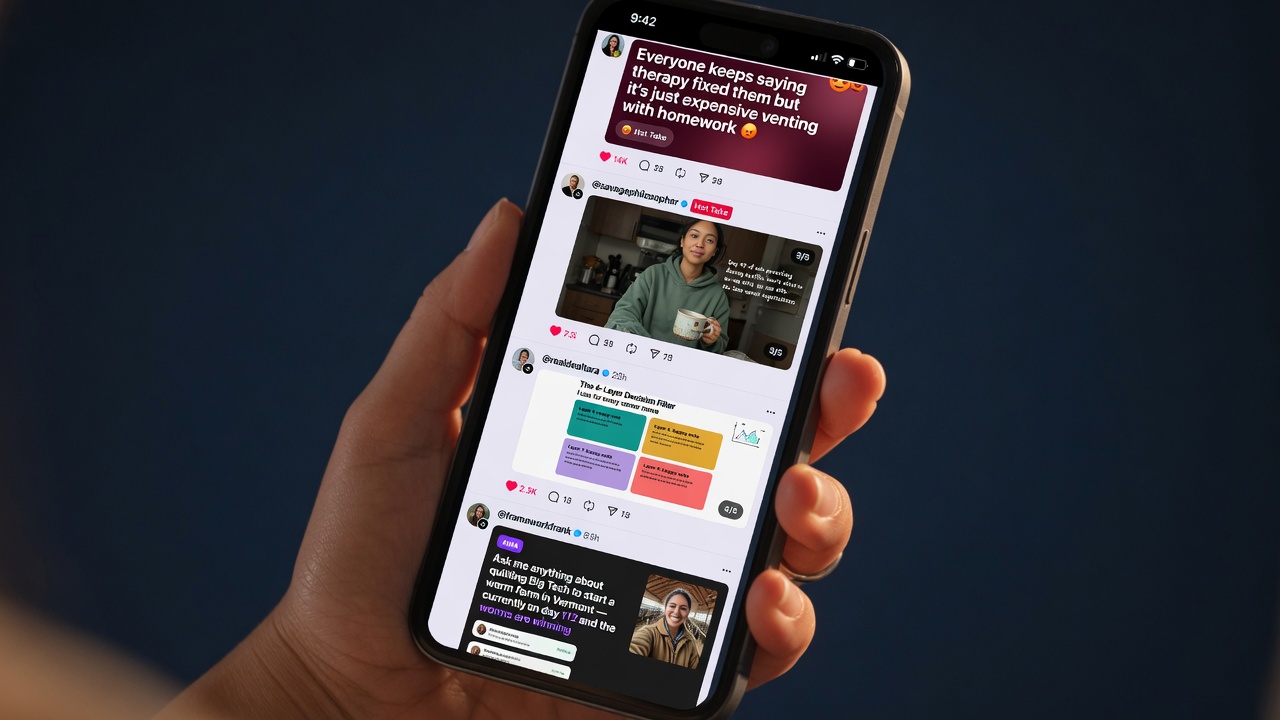
A post idea is useful when it matches the account’s niche, truth, and immediate goal. The same prompt can create a strong post for one account and generic filler for another.
Use these ideas as starting points. Replace every bracket with a real observation, example, customer question, process, or belief from the account.
Quick answer
Choose the goal first, then adapt one prompt with specific account knowledge. Do not copy the prompt as the final post, invent an experience, or force a product mention into an unrelated idea.
Ideas that teach
Teaching posts work when they make one decision easier. Narrow the lesson and show the distinction the reader can use immediately.
- The beginner mistake that makes [task] harder
- A three-step way to decide between [A] and [B]
- What “good” looks like before you measure [result]
- The part of [process] most tutorials skip
- A checklist for reviewing [work]
- One rule you stopped following in [niche]
- The smallest useful version of [project]
- A term people use incorrectly in [niche]
- How to spot a weak [asset] before publishing
- A before-and-after explanation without inflated results
Ideas that start conversation
Conversation prompts need enough context to avoid becoming empty engagement bait. Give the reader a real tradeoff, memory, or decision to respond to.
- Which part of [process] takes you longest?
- What advice in [niche] stopped working for you?
- Would you choose [benefit A] or [benefit B], and why?
- What is a normal problem nobody warns beginners about?
- Which tool did you remove from your workflow?
- What do experts overcomplicate in [niche]?
- What opinion changed after you did the work?
- What would you teach your past self first?
- Which constraint improves your work?
- What is your current unresolved question about [topic]?
Ideas built from stories
Use only stories the account can truthfully claim. A small real moment is more credible than a dramatic invented case study.
- The moment you noticed [problem]
- A decision that felt wrong but proved useful
- A customer question that changed your explanation
- The first version of [asset] and what it missed
- A quiet failure that improved your process
- A conversation that revealed a hidden objection
- The day you removed an unnecessary step
- A result that contradicted your assumption
- The most useful feedback you resisted
- A routine you changed after observing [pattern]
Ideas that demonstrate authority
Authority comes from useful judgment and verifiable evidence, not from declaring expertise. Show how you evaluate work.
- Critique a public example using clear criteria
- Compare two approaches and name the tradeoff
- Explain what you would measure first
- Show a sanitized decision tree
- Break down a common failure mode
- Name the evidence that would change your mind
- Turn a customer FAQ into a complete answer
- Explain why a popular shortcut creates risk
- Share a source with your interpretation
- Describe the boundary of what you know
Ideas for community and promotion
Community posts recognize the reader. Promotional posts connect a relevant problem to an offer without disguising the commercial intent.
- Celebrate a reader milestone without taking credit
- Ask practitioners to add one missing step
- Share a resource list and invite corrections
- Summarize the best answers from a prior discussion
- Thank someone for a specific useful insight
- Show who your product is not for
- Explain the problem your offer deliberately does not solve
- Give away one complete step from a paid process
- Answer the objection that prevents the right buyer from starting
- Invite readers to a free tool that completes the lesson
Turn an idea into a finished post
Select one prompt, add a specific audience, and write the conclusion before the opening. Then build the shortest route from tension to conclusion.
Use the free Threads post creator for a first draft, then replace generic language with account-specific truth and examples.
Action checklist
- Choose one content goal
- Add a specific audience and situation
- Use only truthful experience
- Remove generic niche phrases
- Check that the ending completes the opening
- Enable promotion only when it fits