What this guide is really about
I priced the same digital product at $9, $27, $67, $97, $497, and $997 over 8 weeks. Same Gumroad page. Same product. Same audience. Different prices, rotated weekly. The results were nothing like what every pricing guide told me they'd be.
I spent weeks on pricing research before my first launch. Read every "price at $27" guide I could find. Watched YouTube video after YouTube video about the magic of the $9 impulse buy. Then I ran the actual test and the data made me throw out most of that advice.
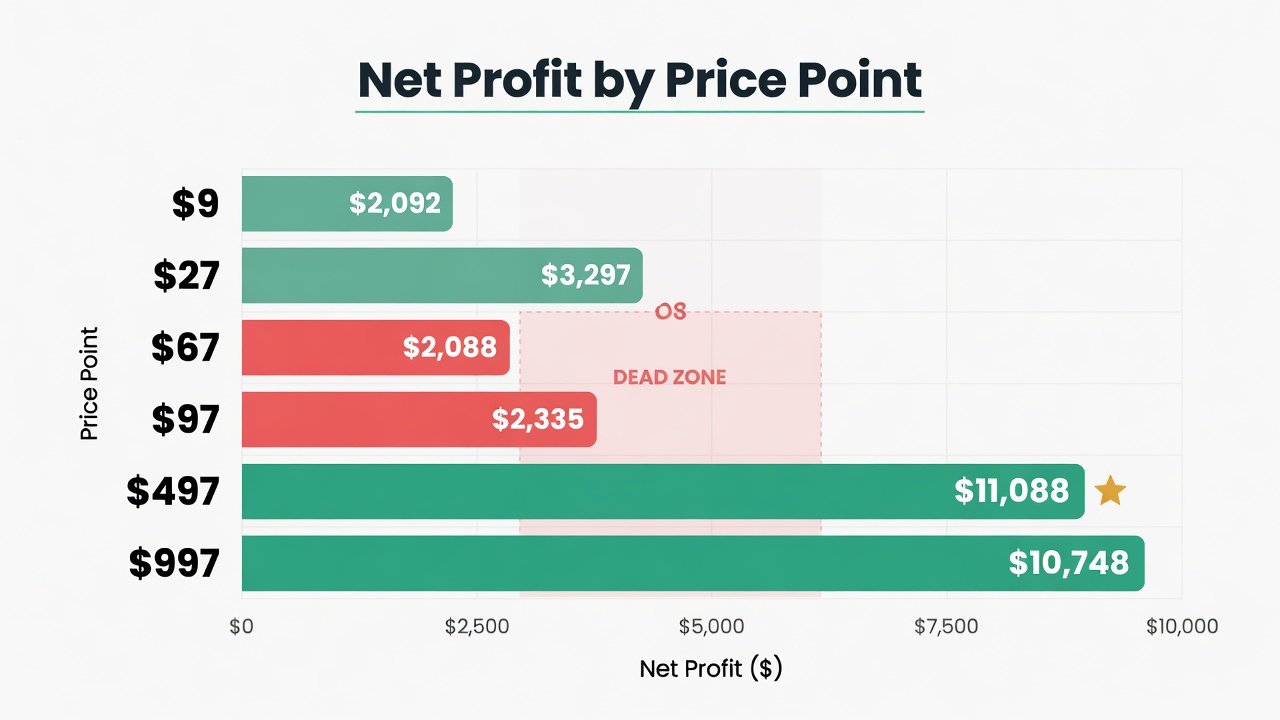
Quick answer: The $497 price point generated $11,088 in net profit. The $9 price point generated $2,092. And the worst range of all was $67 to $97, which I now call the dead zone. Price low for impulse buys or high for serious buyers, but avoid the middle.
The $497 price point generated $11,088 in net profit versus $2,092 at $9. The $67 to $97 range is a dead zone with the lowest net revenue. Price low for impulse or high for serious buyers.

You will see the exact revenue, refund rates, and net profit at every price point
You will learn why the $67-$97 range kills your revenue
You will walk away with a pricing framework you can use for any digital product
The $497 price made 5x more net profit than $9 with 264 fewer customers to support
The $67-$97 range is a dead zone that attracts skeptical buyers with high refund rates
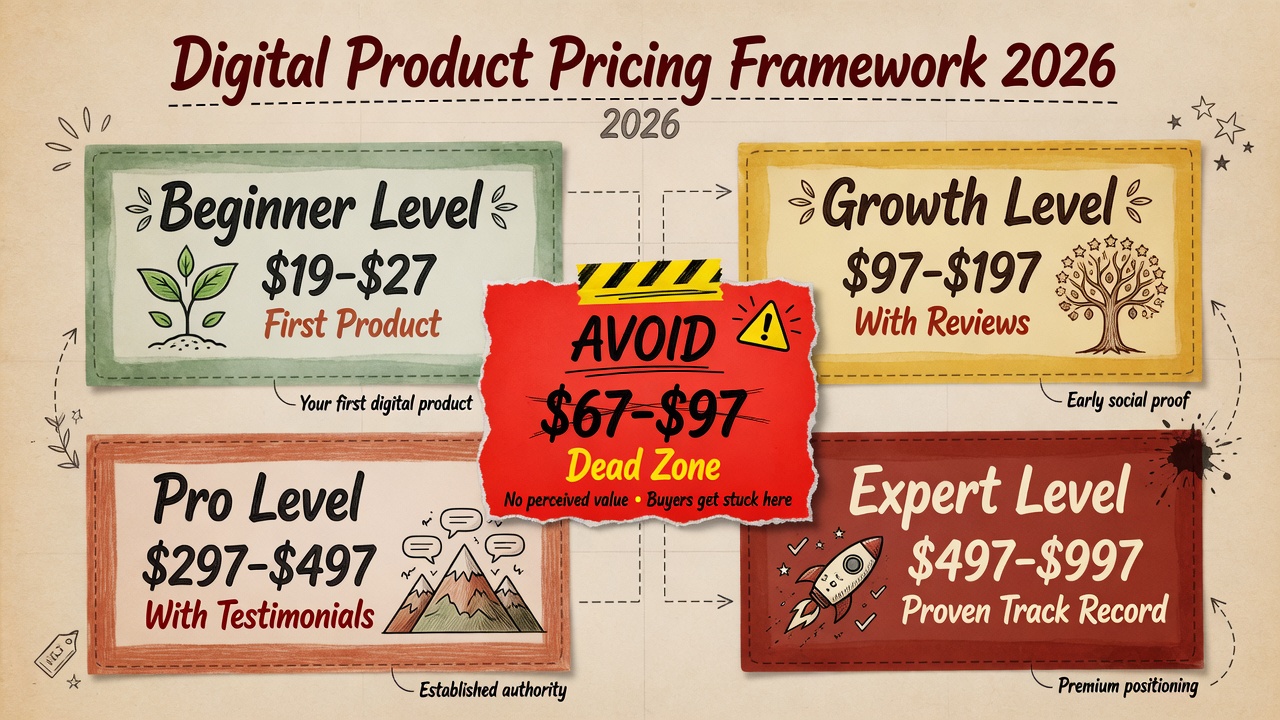
Start at $19-$27 for your first product, then climb the pricing ladder as proof accumulates
Refund rates tell you more about your pricing than sales volume does
Threads is an ideal testing ground for pricing experiments with different audience segments
Why I Ran This Pricing Test (And Why Most Advice is Wrong)
My first Gumroad product launched at $19 because every YouTube video said that was the sweet spot. I made $340 that first month and thought it was fine. Then I saw a creator selling a very similar product at $197, making $4,000 a month. Same niche, same type of product, wildly different revenue. That sent me down a rabbit hole I haven't climbed out of.
Most pricing guides say "start low, build trust, raise prices later." The problem is buyer psychology shifted. People in 2026 either want a $9 impulse buy or a $200+ investment. The middle ground satisfies no one. It feels too expensive to be impulse and too cheap to be premium.
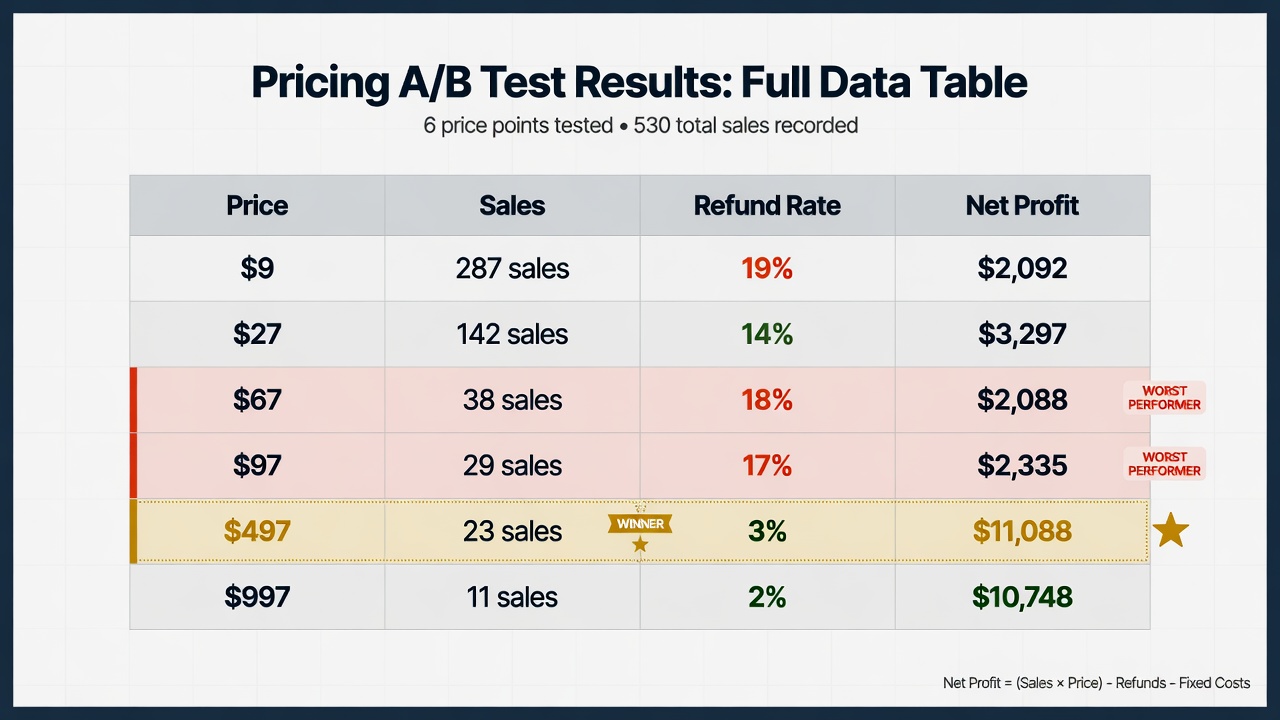
Here is the complete data from the 8-week test. $9: 287 sales, $2,092 net, 19% refunds. $27: 142 sales, $3,297 net, 14% refunds. $67: 38 sales, $2,088 net, 18% refunds. $97: 29 sales, $2,335 net, 17% refunds. $497: 23 sales, $11,088 net, 3% refunds. $997: 11 sales, $10,748 net, 2% refunds.
The $497 price made over 5 times more money with 264 fewer customers. That single insight changed how I price everything.
The $9 Impulse Trap and the $27 Sweet Spot
Two hundred eighty seven sales at $9 sounds incredible until you see the 19% refund rate. That is 55 people asking for their money back. I spent more time on refunds than on creating products. Net profit: $2,092. Decent, but the hidden cost was time. $9 works for lead magnets and email list builders, not for products you want to make real money from.
Then I tested $27. One hundred forty two sales, 14% refund rate, $3,297 net profit. This is the best beginner price. It sits right under the $30 impulse threshold, so the decision feels quick and light. But it filters out the worst refund offenders because there is just enough friction to make buyers pause.
My friend Maya priced her Notion template at $27 and hit $3,800 in her first month. She raised to $47 the next month and sales dropped 40%. The $27 impulse threshold is real. Cross it and you enter different buying psychology entirely.
If you are a beginner, start at $27. Collect reviews. Build social proof. Then move up.
The $67 to $97 Dead Zone: Where Revenue Goes to Die
This is the most surprising finding and probably the most important insight in the whole article. Thirty eight sales at $67, twenty nine at $97. The lowest net revenue of all tiers. At $67 I made $2,088 net, at $97 I made $2,335. Both worse than $27 with a fraction of the sales volume.
Why does this happen? The price is too high for impulse buyers and too low to signal premium value. You attract skeptical mid-tier buyers who expect a lot but won't invest seriously. They buy, feel underwhelmed, and refund at 17-18% rates.
I know a creator who kept her course at $97 for six months, couldn't figure out why it wasn't selling. She bumped it to $297 and sales doubled. The price itself was the problem. At $97 her product sat in the dead zone where nobody feels good about buying.
If you take one thing from this article: the $67-$97 range is the most dangerous place to price a digital product. Test above it or below it. Just don't sit in it.
Pricing based on what feels fair instead of testing actual numbers with real buyers
Starting too high without reviews, testimonials, or social proof to justify the price
Staying too low out of fear and leaving thousands in potential revenue on the table
Ignoring refund rates, which tell you more about your pricing than sales volume
Copying someone else's price without matching their audience size, proof level, and niche

The $497 Gold Mine
I was terrified to price at $497. Thought nobody would buy. Almost didn't run this tier. First week: 4 sales, $1,988. At $9 I needed 28 sales to make the same amount with 28 potential support emails and refund requests. Four customers at $497 means four relationships to manage.
The full numbers: 23 sales, $11,431 gross, $11,088 net, 3% refund rate. Those buyers were different. They actually used the product. Three reached out with implementation questions. Two sent testimonials without being asked. One referred a friend who also bought. That is a flywheel $9 pricing will never create.
The $497 price signals serious value, attracts serious buyers, and creates customers who become advocates. You don't need a huge audience. You need a product that genuinely delivers $497 worth of value and the confidence to ask for it.
The $997 Tier and the Complete Pricing Framework
Eleven sales at $997, nearly $11,000 gross, 2% refund rate. Net profit almost identical to $497 with fewer than half the customers. This tier works when you have comprehensive bundles, coaching packages, or complete systems backed by real testimonials and case studies.
Here is the framework I use now. Step 1: First product, no reviews? Price at $19-$27. Step 2: Have reviews and social proof? Test $97-$197. Step 3: Have testimonials and case studies? Test $297-$497. Step 4: Proven track record? Test $497-$997. Step 5: Avoid the $67-$97 dead zone.
I used this ladder personally. First guide was $19. Six months later with 40 reviews, raised to $47. Now the same product with a bonus module sits at $147 and converts better than it did at $19. The key is climbing intentionally, not jumping overnight.
How Threads Fits Into Your Pricing Strategy
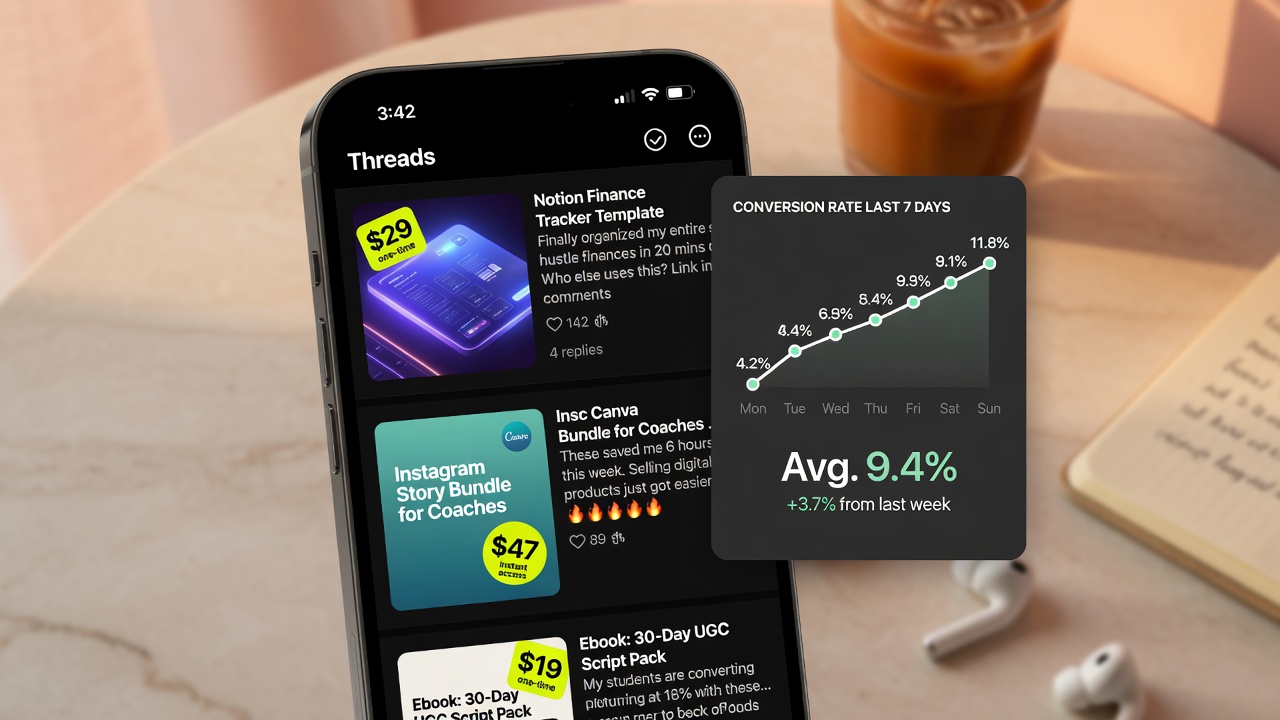
Threads is the perfect testing ground for pricing because you can post different threads targeting different audience segments. One thread pitches your $27 product, another pitches your $97 bundle. The engagement data tells you which price resonates before you commit.
I posted two nearly identical threads a week apart. The $27 thread got 340 likes and 8 sales. The $97 bundle thread got 89 likes and 5 sales. Lower engagement, higher revenue. That is the power of testing price points instead of guessing.
How JoltSage makes this scalable: Running pricing experiments requires consistent traffic. JoltSage lets you schedule pricing test threads at different times, track which price points get the most engagement, and keep posting consistent while you experiment. The scheduling happens in the background so you can focus on the pricing math that moves revenue.
The creators making $3K-$10K per month on Threads aren't the ones posting the most. They're the ones testing and iterating on their offers systematically. Consistent content plus consistent experiments. That is the formula.
Common Mistakes and Your Action Checklist
Five pricing mistakes that kill revenue: pricing based on what feels "fair" instead of testing, starting too high without proof, staying too low out of fear, ignoring refund rates (they tell you more than sales volume), and copying someone else's price without matching their audience and proof level.
Your action checklist: Check your current price against the framework. Pull your refund rate from the last 90 days. If it is above 15%, your price is attracting the wrong buyers. Test one price level up for 2 weeks. Track net profit, not just sales volume. Set up a Threads posting schedule to drive consistent traffic to your test.
Your price is not just a number, it is a signal. It determines who buys, how they use your product, and whether they refund, review, or refer friends. Start by testing one price level up this week. And if you need help keeping Threads traffic consistent while you run pricing experiments, JoltSage handles the posting schedule so you can focus on the math that matters.
Action checklist
Use this as the practical next pass after reading the guide.
- +Check your current price against the 5-step pricing framework in this article
- +Pull your refund rate from the last 90 days
- +If your refund rate is above 15%, your price is attracting the wrong buyers
- +Test one price level up from where you are now for at least 2 weeks
- +Track net profit after refunds and fees, not just raw sales volume
- +Set up a consistent Threads posting schedule to drive traffic to your pricing tests
Frequently asked questions
What is the best price for a first digital product?
Start at $19 to $27. This gives you maximum learning with manageable risk. Your goal with your first product is reviews and feedback, not life-changing revenue.
Why do higher prices lead to fewer refunds?
It is called the commitment effect. When someone invests $497, they have skin in the game. They show up, implement, and make it work. When someone spends $9, there is no commitment. They skim, shrug, and refund.
Should I offer payment plans?
Yes, for anything above $97. Payment plans typically increase conversion by 20 to 40%. They let buyers justify the purchase while spreading the cost.
How do I know if my price is too low?
High sales volume combined with high refund rates and low engagement. If people buy and never actually use your product, the price is attracting window shoppers.
Can I charge $497 for a PDF?
Yes, if the PDF delivers $497 or more in value. Positioning matters more than format. A PDF that helps someone land a $10K client is worth $497 easily.
How often should I test new prices?
Every 2 to 4 weeks, assuming you have enough traffic for meaningful data. If you are getting fewer than 100 visitors per week, focus on growing traffic first.
Does this pricing data apply to Etsy too?
Similar psychology, but Etsy buyers have lower average price tolerance. Test $9 to $47 on Etsy. The dead zone there tends to be $35 to $55.
What if I only have 50 followers on Threads?
Start at $19. Focus on collecting reviews and testimonials. Use each sale as social proof to raise your price over time. Even 50 followers can generate 5 to 10 sales if your product solves a real problem.
Conclusion
Your price is a signal that determines who buys, how they use your product, and whether they come back. The data showed $497 generated 5x more net profit than $9 with far fewer customers.
Start by testing one price level up from your current price this week. The numbers might surprise you.
If you need help keeping Threads traffic consistent while running pricing experiments, JoltSage handles the posting schedule so you can focus on the math that matters.